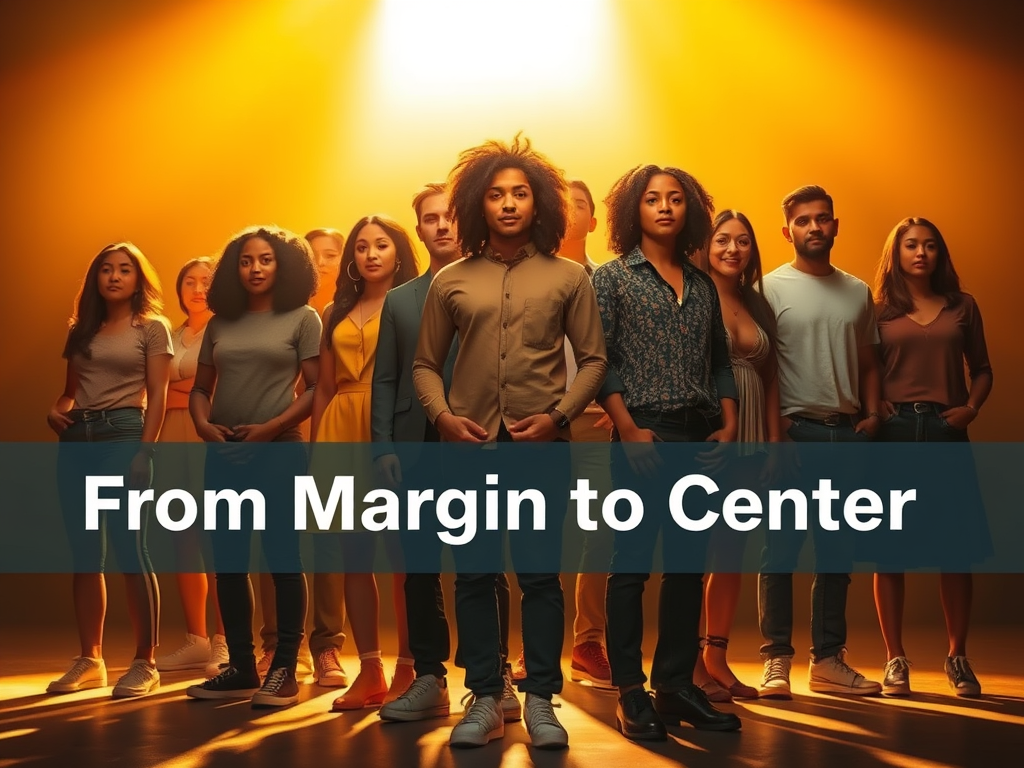

There’s a metaphor that gets used a lot in social justice spaces: bringing people from the margins to the center. It’s meant to be empowering, suggesting that marginalized voices should be heard, that peripheral experiences matter. But here’s the problem with that metaphor—it accepts the premise that we were ever marginal in the first place.
We were never extras in the human story. We were protagonists in narratives that others refused to see, creators of cultures that others appropriated, builders of economies that others took credit for. The margins weren’t our natural habitat—they were where we were pushed, boxed in, and told to stay. But that was never the truth of our existence. And we’re done pretending it was.
The Center Was Always a Lie
Let’s be clear about what “the center” has meant historically: white, male, straight, cisgender, able-bodied, wealthy. That wasn’t the center because it was universal—it was declared the center because it had the power to make declarations. It became the default not through any natural order but through systemic exclusion of everyone else.
This manufactured center then had the audacity to call itself “mainstream” and “normal,” relegating everything else to “niche,” “special interest,” or “diverse.” As if being white and male was somehow neutral while everything else required explanation. As if their stories were about the human condition while ours were about race or gender or sexuality.
But universality was never about who got centered—it was about who got to define what counted as universal. And for too long, that power rested in hands that looked nothing like the majority of humanity.
We Built This
Here’s what they don’t teach in history class: we’ve always been central to everything. Black people built this country—literally, through enslaved labor, and figuratively, through culture that became America’s most valuable export. Indigenous peoples developed agricultural systems, democratic governance structures, and ecological knowledge that still haven’t been surpassed. Asian immigrants built the railroads that connected the continent. Latinx workers have sustained entire industries. Muslim scholars preserved and advanced knowledge during Europe’s Dark Ages.
We didn’t contribute to the story—we wrote it. We didn’t add diversity to the culture—we created it. We weren’t given a seat at the table—we built the damn table.
But historical amnesia is powerful. By erasing our contributions and centering whiteness in every narrative, the dominant culture created a mythology where they were the protagonists and we were supporting characters at best, obstacles at worst.
Reclaiming Centrality
What’s happening now is a reclamation of our rightful place—not as a favor, not as inclusion, but as historical correction. We’re not asking to be brought from margin to center; we’re revealing that we were central all along.
This shows up in how we talk about our accomplishments. We’re no longer content to be “the first” or “the only” or “breaking barriers.” Those framings still position us as exceptions, outsiders who managed to crash the party. Instead, we’re rewriting the narrative to show the systemic barriers that excluded us, the gatekeeping that kept us out, the theft of our innovations and ideas.
When a Black woman becomes a CEO, the story isn’t about how far we’ve come—it’s about how many qualified Black women were passed over before her. When a queer person wins an Oscar, the story isn’t about Hollywood’s progress—it’s about decades of roles we couldn’t play, stories we couldn’t tell, authentic representations that were denied us.
The Multiplier Effect
Here’s what happens when we stop accepting marginal positioning: our impact multiplies exponentially. When you’re trying to succeed from the margins, you’re working twice as hard for half the recognition. You’re constantly justifying your presence, proving your worthiness, code-switching to make others comfortable.
But when you claim centrality—when you operate from the assumption that you belong everywhere—everything changes. You negotiate from strength. You set terms rather than accepting them. You build generational wealth instead of just surviving. You create institutions instead of just joining them.
This is why representation in positions of power matters so much. It’s not just about the individual who gets the job—it’s about how they then open doors, mentor others, shift policies, and change what’s considered “normal” or “acceptable.” One person in the room can be an exception. Ten people in the room change the room. A hundred people, and you’ve changed the institution.
Beyond Inclusion
The language of inclusion is itself problematic because it implies that there’s an inside we need to be let into. But what if we stopped seeking inclusion in spaces that were designed to exclude us? What if instead, we built our own spaces, structures, and systems?
This is already happening. We’re creating our own funding mechanisms, our own distribution channels, our own award systems, our own standards of excellence. We’re defining quality on our own terms instead of accepting their metrics. We’re building parallel structures that don’t require approval from gatekeepers who never wanted us there anyway.
This isn’t separatism—it’s sovereignty. It’s saying: we don’t need you to validate us. We validate ourselves. And if you want to participate in what we’re building, you’re welcome—but on our terms, not yours.
The Center Cannot Hold
The beautiful thing about all this is that the center—the manufactured, exclusionary center—is collapsing. Demographics are shifting. Cultural power is redistributing. The old gatekeepers are losing their grip, and new voices, new platforms, new ways of creating and distributing content are emerging.
What comes next isn’t about replacing one center with another—it’s about recognizing that there never was a single center. There are many centers, many narratives, many ways of being human. The future is polycentric, multiplicitous, kaleidoscopic.
Taking Up Space
The practical implication of all this is simple: stop shrinking. Stop apologizing for taking up space. Stop waiting for permission to be central to your own story, your own field, your own life.
When you walk into a room, you’re not an add-on—you’re the reason the room exists. Your perspective isn’t “diverse”—it’s essential. Your story isn’t niche—it’s human. Your ambition isn’t aggressive—it’s appropriate.
This is what moving from margin to center actually means: not being moved by others, but recognizing that we were never marginal to begin with. We were pushed to the edges, but we never belonged there. And now we’re done performing smallness to make others comfortable.
We’re taking up all the space we deserve. We’re claiming centrality not as a gift but as our birthright. We’re refusing to be extras in a story that couldn’t exist without us.
Because here’s the truth they don’t want you to know: remove us from the narrative, and there’s no narrative left. We’re not supporting characters—we’re the whole damn story. Always have been. We’re just finally insisting that everyone acknowledge it.