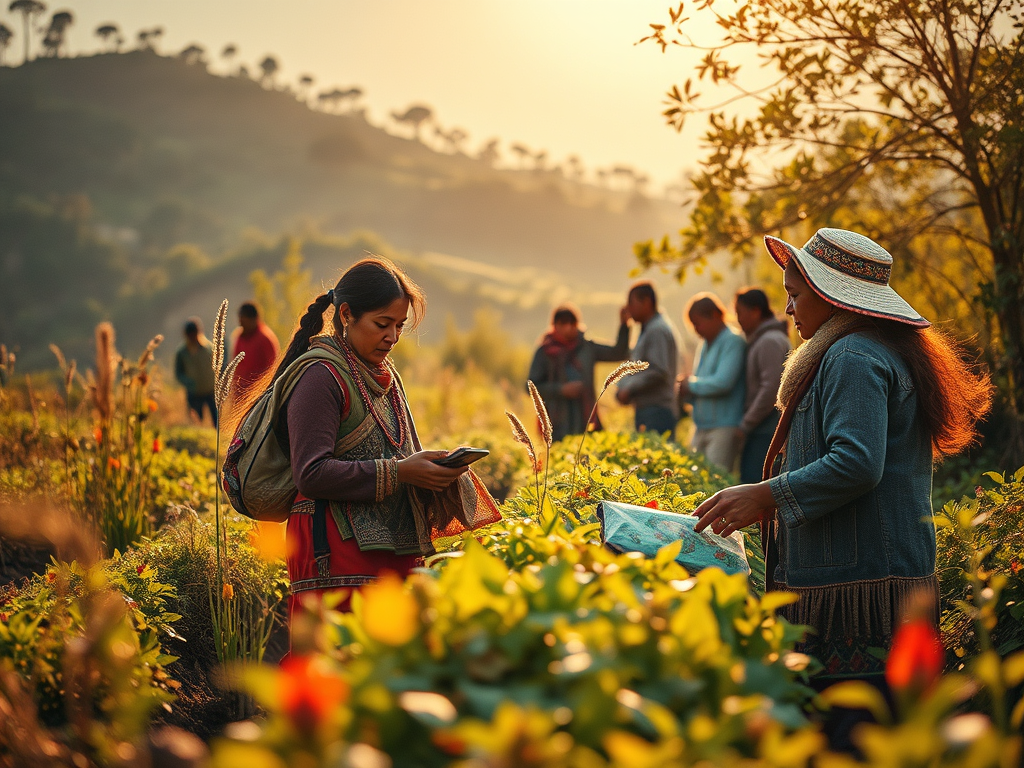

The narrative about Indigenous peoples is often stuck in the past—as if we’re museum exhibits, frozen in time, tragic remnants of a pre-modern world. But Indigenous communities globally are not relics. We are here, we are creating, we are innovating, and we’re doing it by honoring what we’ve always known: that our ancestral wisdom is the blueprint for the future.
Climate Solutions From the Keepers of the Land
While the world scrambles to address climate change, Indigenous communities have been environmental stewards for millennia. We’ve been saying what scientists are now confirming: that biodiversity thrives under Indigenous land management, that controlled burns prevent catastrophic wildfires, that traditional agricultural practices sustain ecosystems.
Indigenous-managed lands contain 80% of the world’s biodiversity despite being only 22% of the world’s land surface. That’s not coincidence—it’s the result of knowledge systems refined over thousands of years.
Today, Indigenous environmental activists like Autumn Peltier fight for water rights. Slash-and-burn farming techniques once derided as primitive are now recognized as sustainable forest management. Traditional knowledge about seed saving and crop rotation informs modern permaculture movements.
The Māori concept of kaitiakitanga—guardianship of the natural world—is being written into New Zealand law. The Whanganui River has legal personhood. Indigenous cosmologies that never separated humans from nature are providing frameworks for environmental law globally.
This isn’t about romanticizing Indigenous peoples as “natural conservationists.” It’s about recognizing that when you live in a place for thousands of years, you develop deep understanding of its ecosystems—knowledge that’s increasingly crucial for planetary survival.
Tech Innovation, Indigenous Style
Indigenous peoples aren’t just preserving the past—we’re shaping the future of technology. But we’re doing it our way, centering community values and cultural preservation.
Apps like Ojibway People’s Dictionary and FirstVoices help preserve and revitalize Indigenous languages. These aren’t just digital dictionaries—they’re multimedia platforms with audio from Elders, contextual usage, and cultural notes. Technology becomes a tool of decolonization.
Indigenous game developers create titles like “Never Alone,” where players experience Iñupiaq culture through gameplay. “Thunderbird Strike” lets players fight oil pipelines. “When Rivers Were Trails” teaches Dakota and Ojibwe history through an Oregon Trail-style game. Gaming becomes education, resistance, and cultural preservation.
Social media has revolutionized Indigenous activism and connection. #NoDAPL organized pipeline resistance. #MMIW brought attention to missing and murdered Indigenous women. TikTok Indigenous creators like James Jones (@notoriouscree) share culture, humor, and education to millions.
Virtual reality projects document sacred sites threatened by climate change and development. Digital archives preserve ceremonies, stories, and knowledge. Technology doesn’t replace oral tradition—it extends it, making it accessible to diaspora community members who might never meet their Elders in person.
Urban Indigenous Renaissance
Over 70% of Indigenous peoples in the US and Canada live in urban areas, but we remain invisible in city narratives. Urban Indigenous communities are creating cultural spaces, social services, and art movements that refuse erasure.
Cities like Minneapolis, Winnipeg, and Albuquerque have thriving Indigenous art scenes. Organizations like the Urban Indian Health Institute provide culturally appropriate healthcare. Indigenous restaurants like Watecha Bowl in Sioux Falls and Tocabe in Denver serve traditional foods with contemporary twists.
Indigenous fashion designers like Bethany Yellowtail and Jamie Okuma create haute couture that honors traditional techniques while pushing boundaries. Their work appears at New York Fashion Week and in museums, forcing recognition of Indigenous artistry.
Street artists like Bunky Echo-Hawk and Cannupa Hanska Luger create work that’s politically charged and culturally grounded. Their murals transform urban spaces into sites of Indigenous presence and resistance.
Language Revitalization as Future-Building
Language death is genocide—the erasure of entire worldviews. But Indigenous communities are fighting back with language revitalization efforts that use every tool available.
Immersion schools teach children in Indigenous languages from kindergarten up. The Hawaiian language, once down to fewer than 100 native speakers, now has thousands of speakers and is thriving. Māori language revitalization in New Zealand serves as a global model.
Hip-hop artists rap in Navajo, Inuktitut, and Māori. Poets write in Cherokee, Cree, and Ojibwe. Language nests—where Elders speak only Indigenous languages with young children—create new native speakers.
This matters because language carries knowledge. Many Indigenous languages have no word for “wilderness” because the concept doesn’t exist when you’re part of the ecosystem. Hawaiian has specific words for types of rain we don’t have names for in English. These linguistic distinctions reflect sophisticated environmental knowledge.
Language revitalization isn’t nostalgia—it’s resistance and reclamation. Every child who speaks their ancestral language is a victory against colonialism.
Decolonizing Education and Knowledge Systems
Indigenous scholars are transforming academia from the inside, challenging Western epistemologies and asserting the validity of Indigenous knowledge systems.
Universities establish Indigenous studies programs led by Indigenous scholars. Research protocols now include community consent and benefit. Traditional knowledge is recognized as intellectual property, protected from exploitation.
Scholars like Vine Deloria Jr., Linda Tuhiwai Smith, and Robin Wall Kimmerer reshape how we understand history, research ethics, and human-nature relationships. Their work isn’t “alternative”—it’s foundational.
Indigenous science is real science. It’s observation refined over millennia. It’s hypothesis testing through generations. Western science is finally catching up, validating what Indigenous peoples have always known about everything from ethnobotany to astronomy.
The future of education includes Indigenous pedagogies: learning through doing, knowledge as relational not extractive, understanding that everything is connected.
Economic Sovereignty and Innovation
Indigenous communities are building economic futures on their own terms. This isn’t about casino capitalism—it’s about sustainable development rooted in cultural values.
Nations invest in renewable energy, becoming leaders in wind and solar power. They develop sustainable tourism that shares culture while protecting sacred sites. They create value-added products from traditional practices—coffee, chocolate, textiles—that benefit communities directly.
Indigenous-owned businesses prioritize community benefit over profit maximization. They practice stakeholder capitalism before it became a buzzword. They understand that economic development must sustain the land and people for seven generations.
B Corps like Native American Natural Foods and Eighth Generation show that Indigenous business models can be both profitable and culturally grounded. They prove that economic sovereignty doesn’t require abandoning values.
Health and Wellness Innovation
Indigenous communities face health disparities resulting from colonialism, but they’re also leading innovations in holistic wellness.
Traditional healing practices are being integrated with Western medicine. Elders work alongside doctors in hospitals. Ceremonies complement therapy. The false binary between traditional and modern dissolves.
Programs addressing intergenerational trauma use culturally specific approaches. Land-based healing reconnects people to place. Language revitalization itself is healing work, reconnecting people to identity.
Indigenous doulas reduce maternal mortality rates by providing culturally appropriate birthing support. Traditional foods movements address diabetes and heart disease while reclaiming food sovereignty.
The future of healthcare is holistic, community-based, and culturally grounded—principles Indigenous healers have practiced forever.
The Path Forward
Indigenous futures aren’t about going back—they’re about going forward with the wisdom of our ancestors. It’s about recognizing that the oldest ways might be the newest solutions. It’s about innovation that doesn’t abandon values.
When Indigenous youth code apps in their ancestral languages, when scientists consult traditional knowledge about climate patterns, when policymakers look to Indigenous governance models for sustainability frameworks—we’re seeing the future.
Indigenous peoples are 5% of the global population but protect 80% of biodiversity. We speak 4,000 of the world’s 7,000 languages. Our knowledge systems have sustained communities for millennia. In a world facing climate catastrophe, pandemic, and social breakdown, maybe it’s time everyone started learning from us.
The future is Indigenous—not because we’re taking over, but because the rest of the world is finally recognizing that we’ve had the answers all along. We’re not vanishing. We’re here. We’re creating. We’re innovating. And we’re doing it by honoring where we come from.