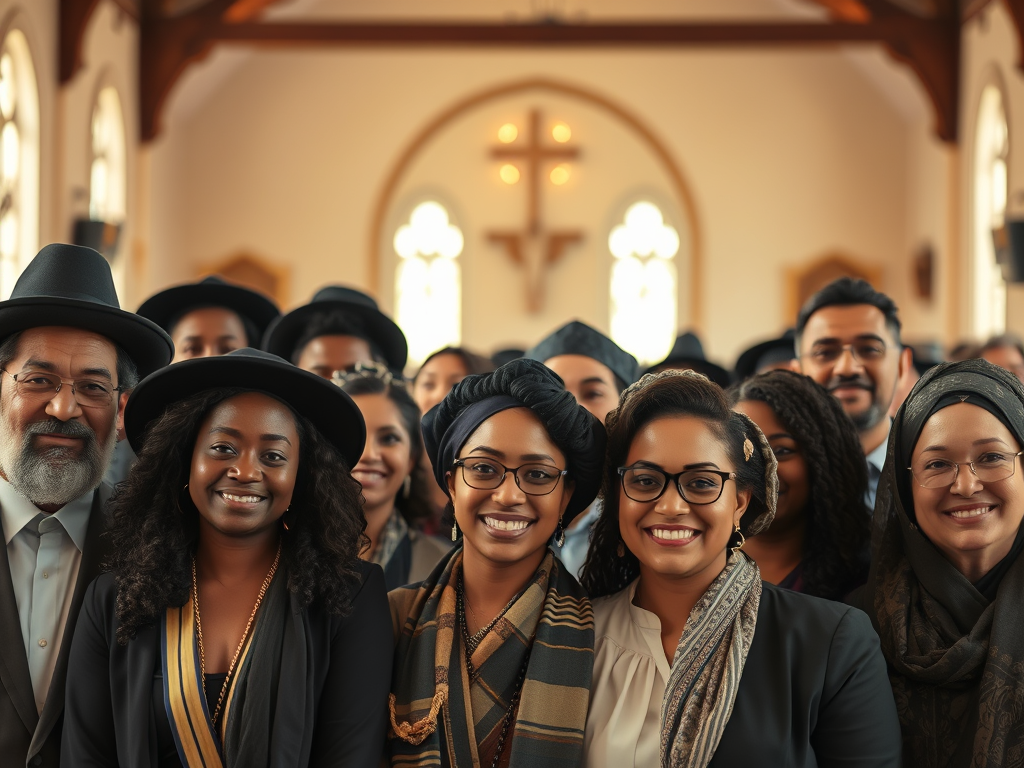

When most people picture a Jewish person, they picture someone white. That assumption erases millions of Jews of color whose identities challenge the neat racial categories America loves to impose. Mizrahi, Sephardic, Ethiopian, Indian, Chinese, Latinx, Black, and multiracial Jews exist—and they’re tired of being told they “don’t look Jewish.”
The Whitewashing of Jewishness
American culture has racialized Jewishness as white, erasing centuries of Jewish diversity. This erasure serves multiple purposes: it distances Judaism from its Middle Eastern roots, it simplifies racial categorization, and it allows Jews of color to be excluded from both Jewish spaces and communities of color.
The reality is more complex. Judaism is a religion and an ethnicity, but not a race. Jews come from every racial background. Some are white. Many aren’t. But American racial dynamics have created a Jewish identity that centers Ashkenazi (European) Jews while marginalizing everyone else.
This whitewashing ignores the fact that most of the world’s Jews aren’t white. It ignores the diversity of the Jewish diaspora. And it creates a situation where Jews of color constantly have to prove their Jewishness.
The “You Don’t Look Jewish” Problem
Jews of color hear this constantly. At synagogue. At Jewish events. From other Jews. From non-Jews. It’s a statement that reveals assumptions about who belongs in Jewish spaces and who doesn’t.
When someone says “you don’t look Jewish,” what they mean is “you don’t look white.” They’re saying your Blackness, your Asian features, your brown skin doesn’t fit their mental image of Jewishness. They’re questioning your authenticity based on appearance.
This happens in both directions. Jews of color are questioned in Jewish spaces and told they can’t be “really Jewish.” In communities of color, they’re sometimes viewed with suspicion or told they’re trying to access white privilege. The result is a particular form of isolation—being too Jewish for some spaces and not Jewish enough for others.
Different Jewish Experiences
Not all Jews of color share the same experiences, and it’s important not to flatten that diversity.
Black Jews navigate anti-Blackness in predominantly white Jewish spaces while also facing antisemitism in Black communities. Some are born Jewish, some are converts, some are adopted—and all of them are tired of having to prove their legitimacy.
Mizrahi and Sephardic Jews have Middle Eastern and North African heritage, but are often treated as less “authentic” than Ashkenazi Jews. Their traditions, languages, and cultural practices get marginalized within broader Jewish culture.
Beta Israel (Ethiopian Jews) faced discrimination in Israel itself, with their Jewishness questioned despite millennia of practice. Those who’ve come to America face both anti-Black racism and internal Jewish hierarchies.
Asian Jews, including communities like the Kaifeng Jews of China and Bnei Menashe of India, have ancient Jewish lineages but are rarely acknowledged in conversations about Jewish diversity.
Latinx Jews bridge multiple identities and often practice Sephardic traditions rooted in the Spanish and Portuguese expulsions.
Antisemitism and Racism: Not Either/Or
Jews of color experience both antisemitism and racism, and those oppressions don’t cancel each other out. They intersect in particular ways that create unique challenges.
When antisemitic attacks happen, Jews of color are often excluded from the Jewish narrative of victimhood. When racist violence occurs, their Jewishness is seen as distancing them from communities of color. They navigate multiple forms of hatred simultaneously.
This intersectionality also means Jews of color often serve as bridges between communities, pushing both Jewish spaces and communities of color to be more inclusive and intersectional in their work.
Representation Matters
Where are Jews of color in media? In Jewish leadership? In conversations about Jewish identity? They’re often absent, tokenized, or treated as exceptions that prove the rule.
This lack of representation reinforces the assumption that Jewishness equals whiteness. It makes Jews of color invisible in their own communities. And it prevents non-Jewish people of color from seeing themselves as potentially Jewish, even if they’re drawn to the faith and culture.
Authentic representation means Jews of color in all roles—not just as the “diverse” character whose Jewishness is their only trait, but as fully developed people whose multiple identities inform their experiences without defining them entirely.
Creating Inclusive Jewish Spaces
Jewish communities that want to be truly inclusive need to do more than just say “all Jews are welcome.” That means examining how whiteness gets centered in Jewish spaces. It means diversifying leadership. It means including diverse Jewish traditions in services and celebrations. It means actively combating racism within Jewish communities.
It also means believing Jews of color when they talk about their experiences. Not questioning their Jewishness. Not tokenizing them. Not expecting them to educate others while simultaneously dismissing their concerns.
Building Solidarity
Jews of color are creating their own communities and networks—spaces where they don’t have to explain themselves or prove their authenticity. Organizations like Jews of Color Initiative, Ammud, and others are centering voices that have been marginalized for too long.
These efforts aren’t about division—they’re about ensuring that all Jews can participate fully in Jewish life. They’re about recognizing that Jewish diversity is a strength, not a problem to be solved.
The Path Forward
The invisibility of Jews of color isn’t accidental—it’s the result of racial and cultural dynamics that benefit from simplistic categorization. Challenging that invisibility means rethinking how American culture understands both Jewishness and race.
It means recognizing that Jews of color have always been here, that their experiences are valid, and that their presence enriches rather than complicates Jewish identity.
You don’t need to look a certain way to be Jewish. Your identity is yours, and it’s legitimate. Full stop.