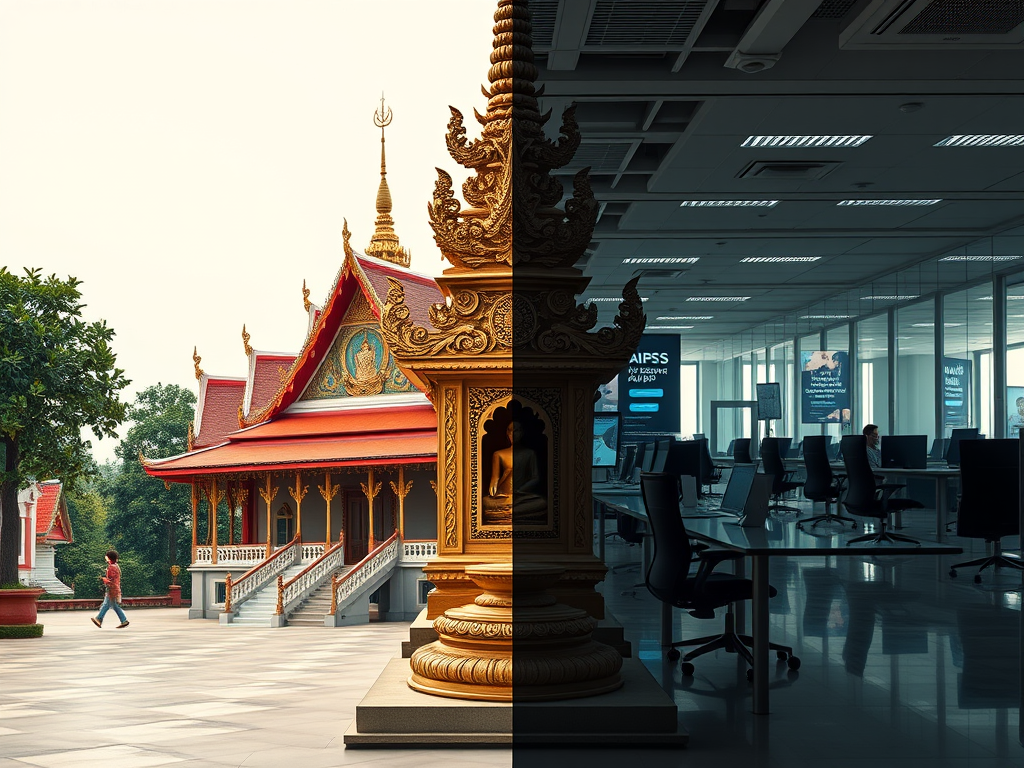

Buddhism in America has been whitewashed. Stripped of its Asian roots, commodified into $100 meditation apps, and repackaged as “mindfulness” for stressed-out professionals. Meanwhile, Buddhist people of color—who’ve been practicing these traditions for millennia—watch their faith get co-opted, simplified, and sold back to them as wellness culture.
The Whitewashing of Buddhism
American Buddhism has a white face. When people think of American Buddhists, they picture white converts meditating in expensive retreats, not the Southeast Asian refugees who built temples in their new communities. They picture yoga studios, not the Chinese and Japanese temples that have existed here for generations.
This erasure isn’t accidental. It’s part of a broader pattern where white Americans extract what they want from Asian cultures—the aesthetics, the practices, the philosophies—while dismissing or excluding actual Asian people.
White Buddhism centers white experiences, white interpretations, and white leadership. It divorces Buddhist practices from their cultural contexts and reframes them as universal techniques available to anyone. That “anyone” usually means white people with disposable income.
Buddhism as Heritage vs. Conversion
For many Asian Americans, Buddhism isn’t a choice—it’s heritage. It’s family temples, childhood rituals, cultural traditions passed down through generations. It’s connected to language, community, immigration stories, and identity.
Convert Buddhism—predominantly white Americans adopting Buddhist practices—often gets more visibility and validation than heritage Buddhism. White Buddhist teachers are published, platformed, and respected. Asian Buddhist teachers are often ignored unless they conform to Western expectations.
This creates a hierarchy where “real” Buddhism is what white converts practice, and heritage Buddhism is viewed as superstitious, cultural, or less authentic. The irony is staggering.
The Mindfulness Industrial Complex
Mindfulness has been stripped from its Buddhist roots and sold as a secular productivity tool. Corporations offer mindfulness training to help employees be more efficient. Apps promise better focus, less stress, enlightenment in ten minutes a day.
This isn’t Buddhism—it’s capitalism dressed in borrowed robes. And Buddhist POC watch as their religious practices get repackaged and sold by people who wouldn’t recognize a Buddhist temple if they walked past it.
The mindfulness movement also ignores the social justice elements of Buddhism. The Buddha taught about suffering and its causes—including systemic oppression. American mindfulness focuses on individual stress reduction while ignoring structural problems. It’s self-help, not liberation.
Cultural Appropriation in Buddhist Spaces
Buddhist imagery is everywhere in American culture—statues as home décor, mantras as tattoos, prayer beads as fashion accessories. None of this includes understanding, respect, or context.
White-led yoga studios and meditation centers often use Buddhist imagery and practices while excluding actual Buddhist POC from their spaces—through pricing, location, cultural norms, or outright discrimination.
When Buddhist POC visit these spaces, they’re often treated as beginners, even if they’ve been practicing since childhood. Their knowledge is dismissed. Their cultural practices are viewed as less “authentic” than Western interpretations.
Immigration and Temple Building
Buddhist communities in America were largely built by immigrants—Chinese, Japanese, Korean, Vietnamese, Thai, Sri Lankan, Tibetan, and others. These communities faced discrimination, exclusion laws, and violence while establishing temples that served as cultural and religious centers.
During World War II, Japanese American Buddhists were incarcerated along with Japanese Americans of other faiths. Their temples were vandalized or seized. After the Vietnam War, Southeast Asian refugees built temples that became anchors for resettlement and community support.
These stories are rarely told in discussions of American Buddhism. The emphasis is on white converts “discovering” Buddhism, not on the Asian Americans who’ve been here practicing it all along.
Different Buddhist Traditions
American Buddhism isn’t monolithic. Different Asian communities practice different traditions—Mahayana, Theravada, Vajrayana—each with distinct beliefs, practices, and cultural expressions.
Chinese American Buddhism looks different from Vietnamese American Buddhism, which differs from Tibetan American Buddhism. Reducing all of this to “mindfulness” erases that diversity and complexity.
Young Asian Americans are reclaiming their Buddhist heritage and creating spaces that honor both tradition and contemporary needs. They’re pushing back against white-centered Buddhism and building communities that reflect their actual identities and experiences.
Mental Health and Buddhism
Buddhism’s emphasis on understanding suffering resonates with many POC navigating racism, trauma, and marginalization. But Western mindfulness often individualizes suffering, suggesting that meditation alone can solve problems rooted in systemic oppression.
Buddhist POC are exploring how their faith addresses both personal and collective suffering. They’re using Buddhist principles to inform social justice work, not as escape from reality but as frameworks for understanding and addressing it.
Representation and Leadership
Buddhist POC are underrepresented in American Buddhist leadership, publishing, and media. White converts dominate Buddhist spaces, write the books, give the talks, and set the agendas.
When Buddhist POC do get visibility, they’re often tokenized or expected to represent their entire ethnic community. Their voices are included only when convenient, not as a matter of course.
Creating authentic representation means centering Buddhist POC in conversations about Buddhism in America. It means recognizing different traditions and experiences. It means compensating teachers of color fairly and including them in leadership.
Reclaiming Buddhist Identity
Buddhist POC are reclaiming their traditions from white appropriation and commodification. They’re building temples and sanghas that serve their communities. They’re writing about Buddhism from their perspectives. They’re challenging whitewashed narratives.
This isn’t about excluding white Buddhists—it’s about centering the communities from whom Buddhism originated. It’s about recognition, respect, and ending erasure.
What Solidarity Looks Like
If you practice mindfulness or meditation, learn where those practices come from. Acknowledge Buddhist sources. Support Buddhist POC teachers and organizations. Don’t reduce Buddhism to stress management techniques.
If you attend Buddhist spaces, notice who’s there and who’s not. Push for inclusive pricing and accessibility. Challenge assumptions about who’s a “real” Buddhist. Support efforts to center heritage practitioners.
The Path Forward
Buddhism in America can be diverse and inclusive, but that requires dismantling white supremacy within Buddhist spaces. It requires recognizing that Buddhism isn’t a universal self-help system—it’s a faith tradition with specific cultural roots.
Buddhist POC deserve to practice their faith without it being commodified, appropriated, or whitewashed. They deserve leadership, recognition, and respect. And American Buddhism needs to reckon with its exclusion and extraction.
Your Buddhist practice is yours. Don’t let anyone tell you it’s less legitimate because of your race or ethnicity. You’re not appropriating your own culture.
If you’re struggling, you don’t have to carry it alone. In the U.S., call or text 988 to reach the Suicide & Crisis Lifeline any time (press 2 for Spanish), text HOME to 741741 for the Crisis Text Line, or, for LGBTQ+ young people, contact The Trevor Project. If you’re in immediate danger, call 911.