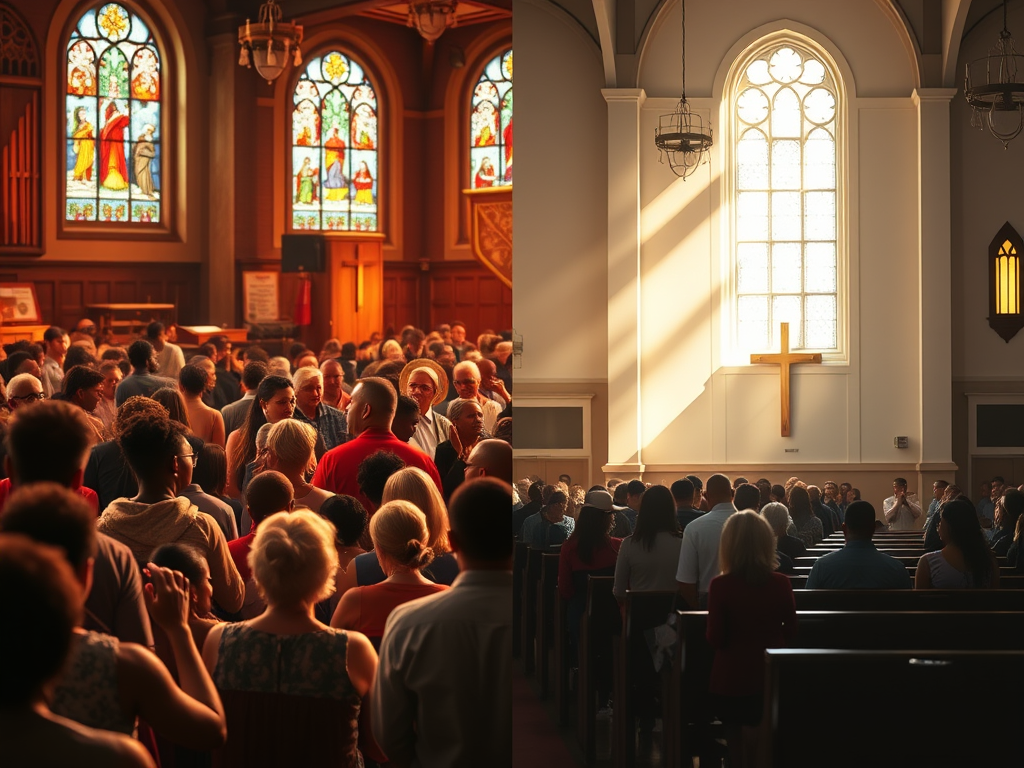

Sunday morning is the most segregated time in America. That’s not hyperbole—churches remain divided along racial lines, reflecting deeper issues about race, culture, power, and whose version of Christianity gets to define what “real” worship looks like. The Black church and white churches practice the same faith but create fundamentally different worship experiences rooted in different histories, needs, and relationships to American society.
Historical Roots of Church Segregation
Church segregation didn’t happen by accident. It was enforced during slavery, when enslaved Black people were either forbidden from practicing Christianity or forced to attend white churches where they sat in segregated sections and heard sermons justifying their enslavement.
When Black people did gain religious freedom, they created their own churches—spaces where they could worship without white surveillance, develop their own theological interpretations, and build community institutions. The Black church became the heart of Black communities: spiritual home, social center, political organizing hub, and safe space.
White churches, meanwhile, supported slavery, then segregation, then more subtle forms of racism. Many white churches explicitly defended white supremacy. Even those that didn’t actively support oppression remained silent or treated racism as someone else’s problem.
This history shapes contemporary church segregation. Black churches were created as refuge and resistance. White churches maintained their power and privilege.
Different Worship Styles
Walk into a Black church and a white church, and you’ll notice immediate differences. Black churches tend toward longer services, call-and-response preaching, gospel music, emotional expressiveness, and congregational participation. White churches often favor shorter services, quieter congregations, hymns or contemporary worship, and reserved emotional expression.
These aren’t just aesthetic preferences—they’re cultural differences rooted in different relationships to suffering, community, and liberation. Black worship emerged from a tradition where church was the one place you could be fully human, could express pain and joy without white censorship. The worship reflects that freedom.
White churches developed in contexts where power and propriety mattered. Worship reflected white cultural norms around emotional restraint, individualism, and order.
Neither style is inherently better, but white churches have historically treated their approach as the standard and Black worship as “too emotional” or “too loud”—judgments rooted in racism rather than theology.
Theology and Social Justice
Black churches have long connected faith to liberation. Black liberation theology centers God’s concern for the oppressed and views faith as calling for social justice. Sermons address systemic racism, police violence, economic inequality, and political power.
Many white churches separate faith from politics (except when politics aligns with their interests). They focus on individual salvation and personal morality while avoiding systemic issues. When they do address justice issues, it’s often from a position of charity rather than solidarity.
This divide reflects different social positions. When you’re oppressed, your faith naturally addresses that oppression. When you benefit from systems of power, it’s easier to spiritualize faith and avoid uncomfortable questions about complicity.
The “Welcoming” Problem
Many white churches claim to be welcoming to people of all races while making zero efforts to actually be inclusive. They expect Black people to assimilate to white cultural norms, worship styles, and leadership structures. When Black congregants ask for changes, they’re told to be patient or that the church “doesn’t see color.”
True welcome requires change, not just permission to attend. It means diversifying leadership, incorporating different worship styles, addressing racism from the pulpit, and redistributing power. Most white churches aren’t willing to do that work.
Black churches face a different pressure: when white people join Black churches, there’s often an expectation that the church should change to accommodate them. The entitlement is staggering—expecting a space created by and for Black people to center whiteness.
Megachurches and Multiracial Myth
Multiracial megachurches often claim to have solved church segregation. They haven’t. Most maintain white leadership, white cultural norms, and white theological frameworks while celebrating superficial diversity.
Black congregants in these spaces often report feeling tokenized, silenced when they raise concerns about racism, and expected to assimilate. The diversity is visual, not structural.
Real multiracial churches require shared power, theological engagement with race and justice, and willingness to be uncomfortable. Most megachurches choose comfort and market appeal over authentic racial reconciliation.
White Evangelicalism and Racism
White evangelicals have consistently supported racist policies and politicians while claiming to be apolitical or focused on “moral issues.” They voted overwhelmingly for politicians who implemented family separation, defended police violence, and gutted civil rights protections.
This isn’t new. White evangelicals opposed civil rights, supported segregation, and created private Christian schools to avoid integration. Their theology centers individual salvation while ignoring systemic sin—particularly the sin of white supremacy they benefit from.
Black Christians, including Black evangelicals, maintain different priorities and voting patterns, but are often excluded from conversations about “evangelicalism” because that term has been implicitly racialized as white.
The Black Church’s Evolving Role
The Black church isn’t monolithic. There are generational tensions, theological debates, and questions about relevance. Young Black people are less religious than previous generations, and many critique the Black church for being homophobic, sexist, or too accommodating to white power structures.
LGBTQIA+ Black people have complicated relationships with Black churches that provided community and support but also preached against their identities. Black women have been the backbone of Black churches while often excluded from leadership.
These conversations are happening inside Black churches, led by people who love their churches and want them to evolve. It’s not rejection—it’s demanding that institutions serve their communities better.
What Reconciliation Requires
Real racial reconciliation in churches requires white churches to do most of the work. That means:
- Acknowledging historical complicity in racism
- Studying Black theology and incorporating it into teaching
- Redistributing power to Black leaders
- Addressing racism explicitly and regularly
- Supporting Black-led justice efforts with resources and bodies
- Being willing to lose white congregants who won’t do the work
- Not expecting Black people to lead this effort or make white people comfortable
It also means recognizing that the Black church doesn’t need saving or fixing by white people. The Black church has always been ahead of white churches on justice issues.
The Path Forward
Church segregation reflects broader American segregation. Ending it requires more than Sunday morning integration—it requires reckoning with history, power, privilege, and fundamentally different understandings of what faith demands.
Maybe churches don’t need to be fully integrated. Maybe Black churches should remain spaces where Black people can worship without white observation or interference. Maybe the goal isn’t integration but solidarity—churches working alongside each other for justice while respecting different spaces and needs.
What’s not acceptable is the current reality: white churches claiming to be colorblind while maintaining white power, Black churches bearing the burden of community survival alone, and everyone pretending Sunday segregation is just about “preference.”
Your church’s position on race reveals its theology. Choose accordingly.