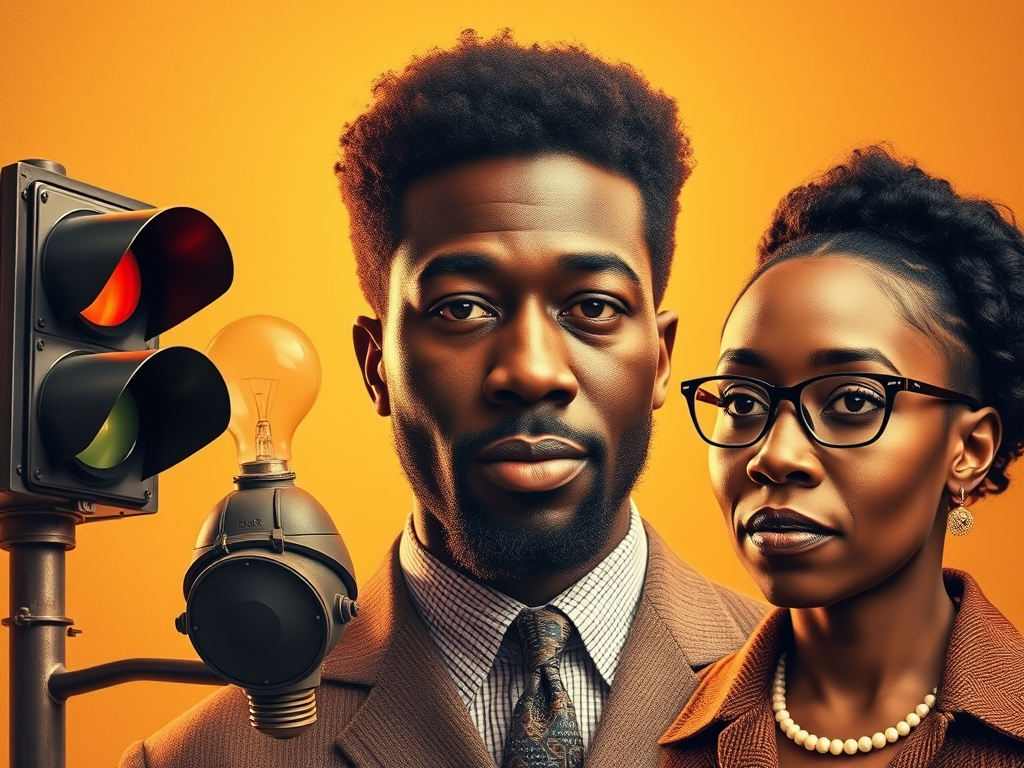

Every time you use a traffic light, a home security system, or even a simple ironing board, you’re benefiting from Black innovation. But chances are, you never learned the names behind these inventions in school.
That’s not an accident. It’s erasure.
The Pattern of Stolen Credit
Black inventors have been robbed of recognition since this country’s founding. Sometimes their white employers took credit. Sometimes patent racism—literally—kept them from filing. Sometimes history just conveniently “forgot” to mention race.
The result? Generations of people think innovation is a white thing, when Black brilliance has been powering progress all along.
Garrett Morgan: The Man Who Saved Lives Twice
In 1914, Garrett Morgan invented the gas mask (called a “safety hood”) that protected firefighters and rescue workers from smoke and toxic fumes. In 1916, when an explosion trapped workers in a tunnel beneath Lake Erie, Morgan and his brother used the device to pull survivors out. Yet early coverage largely overlooked his role, and official recognition was slow to come.
Not deterred, Morgan went on to invent the three-position traffic signal in 1923—you know, the yellow light that prevents crashes at intersections. He sold the patent to General Electric for $40,000. Today, his contribution is footnoted at best.
Lewis Latimer: Edison’s “Forgotten” Partner
Thomas Edison gets all the glory for the lightbulb, but it was Lewis Latimer who made it practical. Latimer invented the carbon filament in 1881, which allowed bulbs to burn longer and cost less. He also drafted the patent drawings for Alexander Graham Bell’s telephone.
Latimer worked directly with Edison, supervised installation of electric street lights in New York and London, and wrote one of the first books on electric lighting, Incandescent Electric Lighting (1890). But history remembers him as Edison’s assistant, if at all.
Dr. Patricia Bath: Restoring Sight, Shattering Barriers
In 1986, Dr. Patricia Bath invented the Laserphaco Probe, a device that uses lasers to remove cataracts more precisely, and patented it in 1988. Her work has helped restore sight to people around the world.
She was the first Black female doctor to receive a medical patent, and the first Black person to complete a residency in ophthalmology at New York University. She co-founded the American Institute for the Prevention of Blindness. And yet, most people have never heard her name.
Lonnie Johnson: From NASA to Super Soakers
You definitely played with his invention—the Super Soaker. But Lonnie Johnson is a NASA engineer who worked on the Galileo Jupiter probe and the Mars Observer project. His water gun was a byproduct of working on a heat pump that used water instead of Freon.
Johnson holds over 120 patents, including innovations in energy technology. But he’s famous for a toy because that’s the safe narrative: Black people as entertainers, not engineers.
Marie Van Brittan Brown: Your Home Security System
In 1966, Marie Van Brittan Brown invented the first home security system because police response times in her Queens neighborhood were dangerously slow. Her design included video surveillance, two-way audio communication, and a remote door lock—all controlled from inside the home.
Sound familiar? Her patent laid the groundwork for every modern home security system. Ring doorbells, ADT, all of it traces back to a Black woman protecting her family when the system wouldn’t.
The Systematic Erasure
These aren’t feel-good stories about “overcoming” racism. These are indictments of a system that stole, ignored, and minimized Black genius for profit and propaganda.
Black inventors didn’t just contribute despite racism—they innovated because of the problems racism created. When hospitals segregated care, Black doctors like Daniel Hale Williams and Charles Drew pushed surgery and blood banking forward. When police ignored Black neighborhoods, Black engineers created security systems. When mainstream products didn’t serve Black needs, Black entrepreneurs built alternatives.
Why This Still Matters
The myth that innovation belongs to white men justifies ongoing inequality. It’s why venture capital funding goes overwhelmingly to white founders. It’s why STEM fields remain hostile to Black students. It’s why “diversity in tech” is treated like charity instead of correction.
When we don’t teach Black innovation, we raise another generation believing brilliance has a color—and it’s not ours.
What You Can Do
Learn these names. Teach them to your kids. Demand schools integrate Black inventors into science and history curriculum year-round. Support Black-owned tech companies and patent attorneys who help Black inventors protect their work.
And the next time someone acts surprised that a Black person is an engineer, a scientist, or an inventor, remember: we’ve always been here. We’ve always been creating.
History just keeps trying to write us out.
Keep reading: The Harlem Renaissance and Its Modern Echoes · Reclaiming the Classics, Redefining Identity: A New Publishing Vision from Minorities.com and Rose Angel Publishing · Black Wall Street: What Tulsa Taught Us About Economic Power