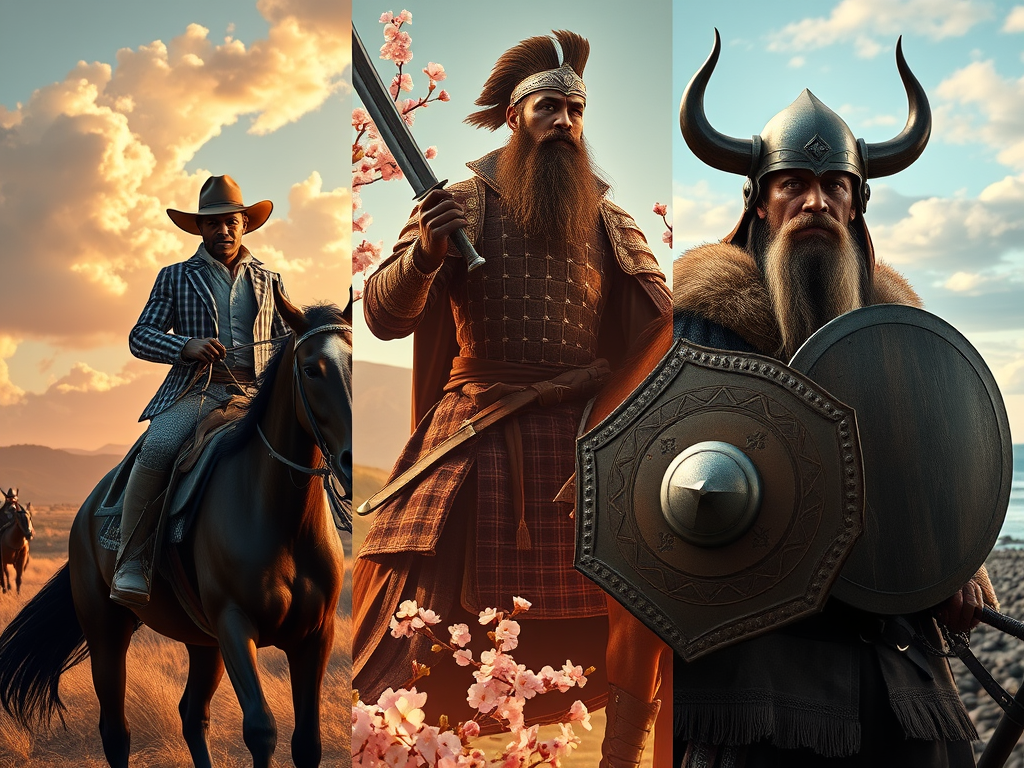

Pop culture loves cowboys, samurai, and Vikings. What it doesn’t love is admitting that Black people were all three.
History isn’t as white as Hollywood pretends. Black cowboys rode the American frontier. Black samurai served in feudal Japan. Africans and people of African descent moved through medieval Europe and the Viking world. These stories were overlooked, and sometimes deliberately erased.
Let’s bring them back.
Black Cowboys: One in Four
Historians estimate that as many as one in four cowboys in the American West were Black. That’s roughly 8,000 Black cowboys out of 35,000 total.
After the Civil War, formerly enslaved people headed West seeking land, work, and freedom from Southern terrorism. Cattle drives needed labor, and race mattered less than skill when you were weeks away from civilization.
Black cowboys did the same work—breaking horses, herding cattle, sleeping under stars, and facing danger. Some became legends.
Nat Love, known as “Deadwood Dick,” was a champion rodeo rider and sharpshooter. His autobiography described his life on the frontier in detail, but Hollywood preferred white cowboys.
Bass Reeves was a U.S. Marshal who arrested over 3,000 criminals and killed 14 in self-defense. He worked in what’s now Oklahoma, navigating hostile territory while Black. He’s believed to be the inspiration for the Lone Ranger—a character who was whitewashed into oblivion.
Bill Pickett invented bulldogging (steer wrestling) and became a rodeo star. He performed across the U.S. and internationally, but mainstream history barely remembers him.
Black cowboys existed, excelled, and shaped the West. But Western films cast white actors and wrote Black people out entirely.
Yasuke: The African Samurai
In 1579, an African man arrived in Japan with Italian Jesuit missionaries. His name was Yasuke, and he is widely regarded as the first foreign-born man to hold samurai status (historians still debate the exact title).
Yasuke’s presence fascinated Japanese people, many of whom had never seen a Black person. Oda Nobunaga, one of Japan’s most powerful daimyos (feudal lords), was so impressed by Yasuke that he made him a samurai and bodyguard.
Yasuke fought in battles alongside Nobunaga, carried his weapons, and was granted a residence and a katana—honors reserved for samurai. When Nobunaga died, Yasuke fought to defend his heir before being captured.
Japanese records confirm his existence. He’s mentioned in letters, diaries, and historical documents. And yet, most people have never heard of him because Black people aren’t “supposed” to be in Japanese history.
(Note: Netflix’s Yasuke anime brought attention to his story, but it’s still largely unknown outside niche historical circles.)
The Moors and Medieval Europe
The Moors—North African Muslims of Berber and Arab descent, many with Black African heritage—ruled parts of Spain and Portugal for over 700 years (711-1492 AD).
They brought advanced mathematics, medicine, architecture, and astronomy to Europe. Universities in Córdoba and Granada rivaled anything in the Christian world. They translated Greek and Roman texts that preserved Western philosophy.
When Europeans talk about the Renaissance, they often skip the part where Moorish scholars reintroduced them to their own intellectual heritage.
Black Africans were also present in medieval Europe as traders, soldiers, and nobility. St. Maurice, a Black Christian saint, is depicted in European religious art. African musicians and scholars moved through European courts.
But medieval Europe is portrayed as exclusively white in media, textbooks, and popular imagination.
Black Vikings
The Viking world was far more connected than the movies suggest. Norse traders reached Baghdad and North Africa, and Irish annals record Viking raiders bringing North African captives, whom they called “blámenn,” to Ireland in the 860s. Genetic studies show Viking-age Scandinavia had more varied ancestry than the “pure Nordic” myth claims. The evidence for Black Viking warriors is thin, but the idea of an all-white, sealed-off North is a modern fantasy.
But popular culture prefers blonde, blue-eyed Vikings. Any deviation is labeled “woke” or “historically inaccurate”—even though actual history proves otherwise.
Why This Matters
Erasing Black people from history isn’t accidental. It’s political.
If Black people only exist in narratives of slavery and oppression, it suggests we’re naturally inferior—only fit for subjugation. If we’re removed from stories of exploration, adventure, and heroism, it implies we didn’t contribute to human progress.
Whitewashing history justifies present-day inequality. It tells Black children they have no legacy of greatness. It tells white children they’re the default heroes.
Both are lies.
The Pushback
Whenever Black characters appear in historical or fantasy settings, from The Rings of Power to period dramas,people rage about “forced diversity” and “historical accuracy.”
But they’re fine with dragons, magic, and time travel in their fiction. The only “unrealistic” element, apparently, is Black people existing.
That’s not about accuracy. It’s about maintaining white dominance in storytelling.
Reclaiming These Histories
Creators of color are reclaiming these narratives. Films like The Harder They Fall (a Black Western) and books like Daughter of the Moon Goddess (Chinese-mythology fantasy) prove audiences want stories that reflect reality’s diversity.
Historians and archaeologists are doing the work to uncover erased histories and make them accessible.
But the fight isn’t over. Textbooks still center white narratives. Museums still marginalize Black contributions. Hollywood still defaults to all-white casts for historical epics.
What You Can Do
Learn the real history. Read about Yasuke, Bass Reeves, and the Moors. Watch documentaries that center Black perspectives.
Support diverse storytelling. Watch films and shows with Black leads in genres beyond slavery and civil rights. Buy books by Black authors writing fantasy, sci-fi, and historical fiction.
Challenge erasure. When someone claims Black people in a historical setting are “unrealistic,” educate them. Cite sources. Push back.
Teach the next generation. Kids deserve to know that Black people have always been explorers, warriors, scholars, and adventurers—not just enslaved or oppressed.
Black people have always been everywhere, doing everything. History just keeps trying to pretend we weren’t.
Don’t let them.
Keep reading: Black Joy as Resistance in 2026 · Juneteenth vs. Independence Day: Whose Freedom? · Bayard Rustin: The Gay Man Behind the March on Washington