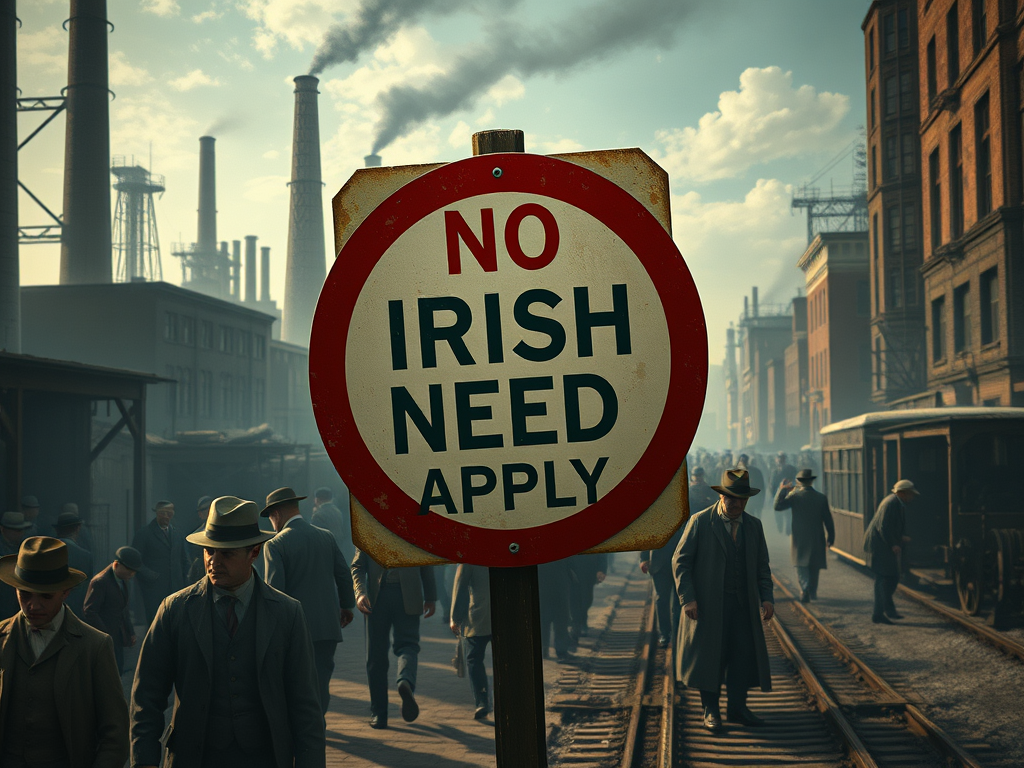

The myth of universal white privilege has always been more complicated than modern discourse suggests. For Irish immigrants arriving in America during the 19th century, their pale skin offered no protection from poverty, violence, or systematic discrimination that would shape generations.
Between 1845 and 1855, over one million Irish fled the devastating potato famine. They arrived in American cities desperate, hungry, and Catholic in a predominantly Protestant nation that viewed them with open contempt. What followed wasn’t just cultural adjustment—it was survival against a system designed to keep them at the bottom.
The Signs Were Real
“No Irish Need Apply” signs became shorthand for economic exclusion. While some historians debate their prevalence in physical signage, the sentiment was undeniable in newspaper advertisements, employer policies, and social practice. Irish immigrants found themselves competing for the lowest-paying, most dangerous jobs: building railroads, digging canals, working in factories where American-born workers refused to go.
Irish women fared slightly better, dominating domestic service positions. But this “opportunity” meant living in employer homes, subject to constant supervision, with little autonomy or respect. The phrase “Bridget” became derogatory slang for Irish maids, reducing an entire community of women to a stereotype.
Not White Enough
Here’s what complicates the narrative: Irish immigrants occupied a racial liminal space that challenges modern assumptions about whiteness as a fixed category. Political cartoons of the era depicted Irish people with exaggerated features—ape-like, brutish, primitive. They were called “white n\\\\\*s” and “smoked Irish,” language that explicitly positioned them outside acceptable whiteness.
Scientific racism of the period classified Irish as Celtic, a supposedly inferior race to Anglo-Saxons. Phrenologists measured Irish skulls and declared them closer to Africans than Europeans. This wasn’t casual prejudice—it was pseudoscience deployed to justify economic exploitation and political exclusion.
The irony cuts deep: Irish immigrants often lived alongside free Black Americans in the same overcrowded tenements, competed for similar jobs, and faced overlapping discrimination. Yet instead of building solidarity, many Irish Americans adopted virulent anti-Black racism as a strategy for acceptance, trading one form of oppression for complicity in another.
Catholic in Protestant America
Religious discrimination compounded economic marginalization. Anti-Catholic sentiment ran deep in 19th century America, fueled by Protestant fears of papal influence and foreign loyalty. The Know-Nothing Party explicitly campaigned against Irish Catholic immigration, achieving significant political power in the 1850s.
Irish children faced harassment in public schools that mandated Protestant Bible readings. Catholic churches were burned. Priests were attacked. The 1844 Philadelphia Nativist Riots left dozens dead and Irish neighborhoods destroyed, all because Irish Catholics demanded their own schools and religious freedom.
This wasn’t ancient history for Irish American communities. Grandparents and great-grandparents carried stories of signs that said “No Catholics,” of being called “Papists,” of having their faith treated as foreign contamination. These memories shaped family identity long after Irish Americans achieved economic mobility.
From Outsider to Insider
The transformation of Irish Americans from despised immigrants to acceptable whites didn’t happen through moral enlightenment—it happened through deliberate strategy and structural opportunity. Irish immigrants organized politically, building powerful machines in cities like Boston and New York. They leveraged their numbers, their votes, and eventually their economic power.
Military service accelerated acceptance. Irish Americans fought in enormous numbers during the Civil War, using battlefield sacrifice to claim American identity. Police and firefighting careers offered stable employment and public visibility, reshaping Irish Americans from threats to protectors of order.
By the early 20th century, Irish Americans had largely crossed the color line, accepted into the category of whiteness that had initially rejected them. But this acceptance came with costs: cultural assimilation, language loss, and as mentioned, participation in the oppression of Black Americans and newer immigrant groups.
What We Lost in Translation
Most Irish Americans today have no memory of the Irish language. Gaelic died in American families within two generations, deliberately suppressed by parents who wanted their children to sound American. Names were anglicized—O’Reilly became Riley, surnames were shortened or changed entirely.
Food traditions simplified or disappeared. Music survived better, but often in commodified forms stripped of context. The rich storytelling tradition, the poetry, the complex relationship with British colonialism—all reduced to St. Patrick’s Day parades and “Kiss Me I’m Irish” t-shirts.
This cultural amnesia isn’t unique to Irish Americans, but it represents a particular kind of loss: heritage traded for acceptance, distinctiveness exchanged for safety. The cost of becoming white was becoming generic.
Why This History Matters Now
Understanding Irish American history doesn’t diminish ongoing racial injustice against people of color. It doesn’t create false equivalencies between historical Irish discrimination and contemporary systemic racism. What it does is complicate our understanding of how whiteness works as a social category—fluid, strategic, and always enforced through power rather than biology.
For Irish Americans today, this history offers an invitation to complexity. You can acknowledge the discrimination your ancestors faced while recognizing the privileges you’ve inherited. You can grieve cultural loss while refusing to weaponize that grief against current immigrants. You can reclaim heritage without romanticizing the past or ignoring how your community participated in oppressing others.
The Irish American story isn’t about competing for “most oppressed” status. It’s about understanding how systems of power create outsiders, how those outsiders sometimes gain inclusion through excluding others, and how identity is always more complicated than contemporary politics suggests.
Your great-great-grandparents weren’t white enough for America. Now you are. That transformation tells us something important about race in America: it was never about biology. It was always about power.