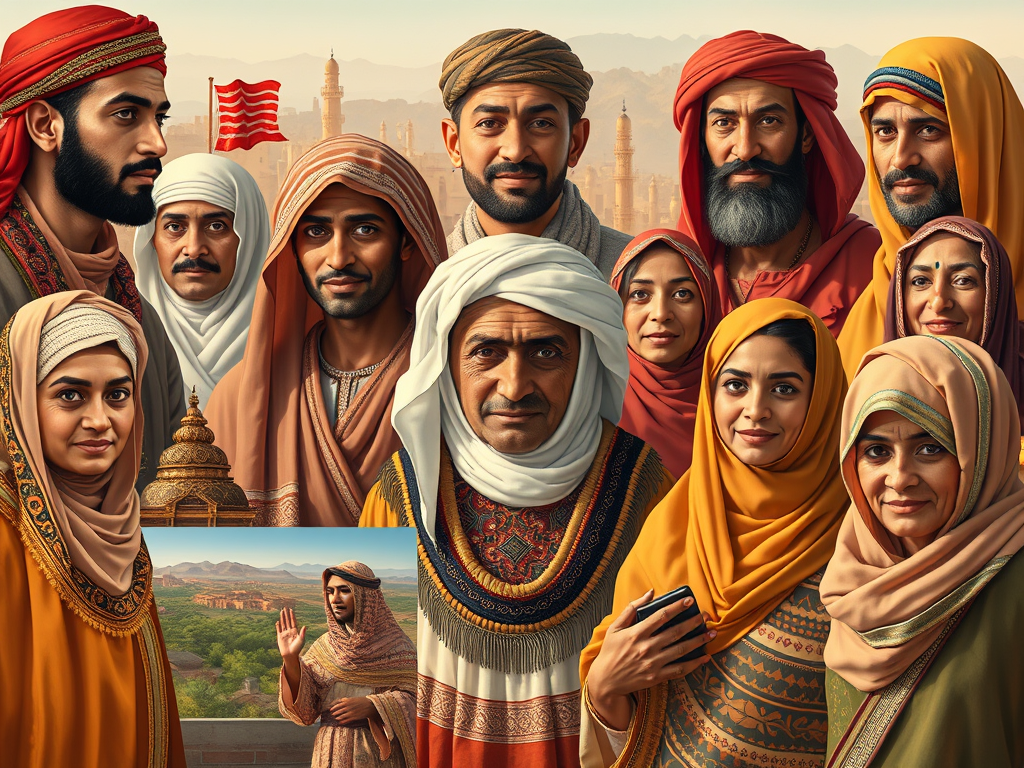

If there’s one thing Arab Americans are tired of hearing, it’s that they’re all the same. Twenty-two countries, hundreds of millions of people, thousands of years of history—and somehow, Americans think “Arab” means one culture, one religion, one experience.
Let’s shatter that myth right now.
Geographic Diversity: More Than a Region
“Arab” refers to people from the Arab world, a region spanning from Morocco to Oman. That includes North Africa (Egypt, Libya, Tunisia, Algeria, Morocco, Sudan, Mauritania) and Western Asia (Lebanon, Syria, Jordan, Palestine, Iraq, Saudi Arabia, Yemen, Kuwait, Bahrain, Qatar, UAE, Oman).
Each country has distinct cultures, dialects, foods, music, and histories. A Moroccan American’s experience differs vastly from a Syrian American’s. An Egyptian American might have almost nothing in common with a Yemeni American except a language family.
Regional differences run deep. Levantine culture (Lebanon, Syria, Palestine, Jordan) shares more with Mediterranean traditions. Gulf culture (Saudi Arabia, UAE, Kuwait) has its own distinct identity. North African culture blends Arab, Berber, and African influences in ways that don’t exist elsewhere.
Religious Pluralism: Beyond Islam
Here’s what surprises most Americans: the majority of Arab Americans are Christian. Lebanese Maronites, Egyptian Copts, Syrian Orthodox, Iraqi Chaldeans—these communities have practiced Christianity since the religion’s earliest days.
Arab Muslims are incredibly diverse too. Sunni and Shia Islam represent major branches, but within those exist countless traditions and interpretations. Some Arab Americans are Druze, a unique faith that emerged in the 11th century. Others are Jewish, maintaining ancient communities that predate Islam.
Many Arab Americans are secular, agnostic, or atheist. Religious identity varies within families, between generations, and across individuals. Assuming all Arab Americans are Muslim isn’t just wrong—it erases the majority.
Class and Immigration Waves
Arab Americans arrived in waves, each shaped by different circumstances:
Late 1800s to early 1900s: Primarily Christian Lebanese and Syrian immigrants seeking economic opportunity. Many became peddlers and entrepreneurs.
Post-World War II: Palestinians displaced by the creation of Israel. Egyptians after Nasser’s revolution. Iraqis fleeing political instability.
1970s-1990s: Lebanese fleeing civil war. Palestinians from occupied territories. Yemenis seeking work.
2000s-present: Iraqi refugees after the U.S. invasion. Syrian refugees after 2011. Yemenis escaping war.
Each wave brought different class backgrounds, education levels, and reasons for leaving. Early immigrants often came with resources. Recent refugees arrived with nothing but trauma. These differences shape communities in profound ways.
Urban vs. Suburban vs. Diaspora
Arab Americans cluster in different regions. Dearborn, Michigan has one of the largest Arab American populations in the country. Brooklyn’s Bay Ridge has thriving Arab communities. Los Angeles, Chicago, and Houston have significant populations too.
But thousands of Arab American families live in suburbs and small towns where they’re the only ones. Their experience of isolation differs completely from those in ethnic enclaves.
Generational Divides
First-generation Arab immigrants often maintain strong ties to their home countries, speak Arabic fluently, and hold traditional values. Second-generation Arab Americans navigate two worlds, often serving as cultural translators for their parents. Third and fourth-generation Arab Americans may have tenuous connections to their heritage, speaking little or no Arabic.
These generational differences create tension. Older generations see younger ones as “too American.” Younger generations see their elders as “stuck in the past.” Neither is wrong—they’re just living different realities.
Political Diversity: No Single View
Arab Americans hold diverse political views shaped by their backgrounds. Some are conservative, especially Lebanese Maronites and Chaldeans. Others are progressive, particularly those from Palestinian and Yemeni communities. Many are politically disengaged, exhausted by being blamed for Middle Eastern conflicts they didn’t start.
Foreign policy views vary too. Arab Americans don’t universally agree on Palestine, Syria, Yemen, or any other regional issue. Family histories, religious backgrounds, and personal values all influence perspectives.
Identity Negotiations
Some Arab Americans identify primarily by nationality: Lebanese American, Egyptian American, Palestinian American. Others embrace pan-Arab identity. Still others reject “Arab” entirely, identifying instead as Amazigh (Berber), Assyrian, or by other ethnic markers.
Mixed Arab Americans navigate even more complexity, especially those with one Arab parent and one non-Arab parent. They face questions about “authenticity” from both sides.
What This Means for Community
Diversity creates both challenges and strengths. Arab Americans don’t always agree, don’t always get along, and don’t always prioritize the same issues. That’s okay. No community is monolithic.
The key is recognizing that diversity while building coalitions around shared experiences: discrimination, stereotyping, invisibility in data, and the pressure to constantly explain or justify your existence.
You don’t need to represent all Arab Americans. You can’t. You’re one person with one story, and that’s enough. The goal isn’t unity for unity’s sake—it’s making space for all Arab American experiences to exist without erasure.
Your specific identity matters. Don’t let anyone flatten it into a stereotype.
Keep reading: Arab American Contributions to Science and Medicine · Arab American Art, Literature, and Cultural Renaissance · Palestinian Identity and Diaspora in America