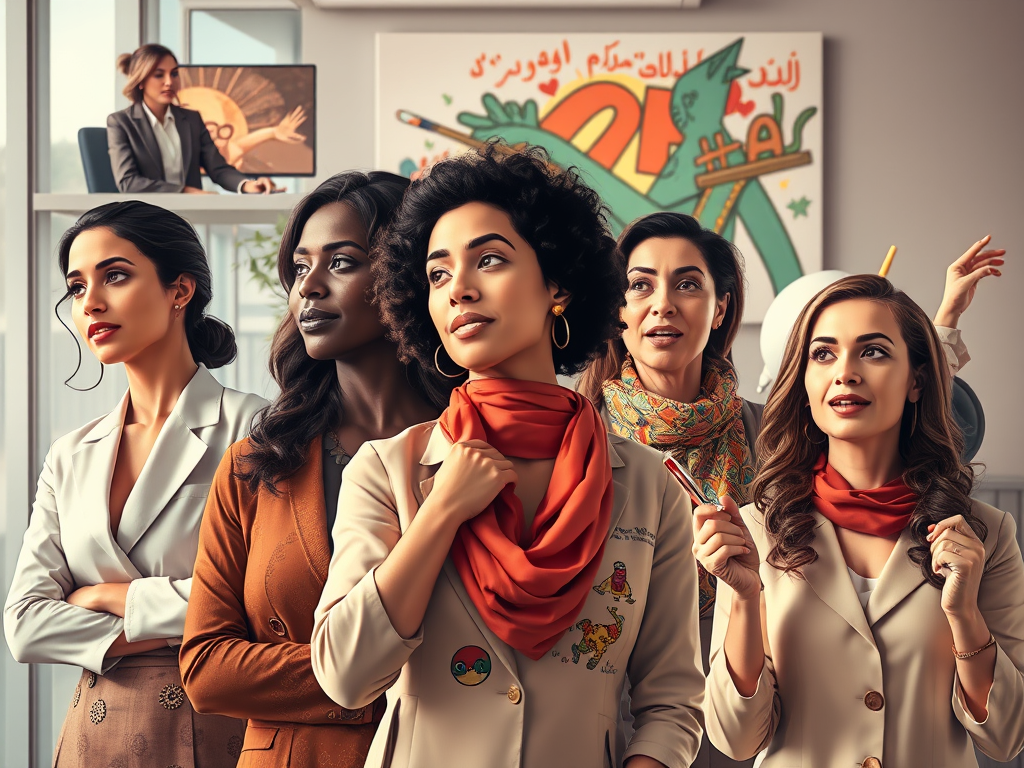

Arab American women navigate a particular intersection: stereotyped as oppressed by their own culture while discriminated against by mainstream American society. They’re told they need saving from Arab men while facing sexual harassment from American men. They’re expected to be submissive while criticized for being too assertive.
Instead of waiting for anyone’s permission, Arab American women are building empires, leading movements, and redefining what power looks like.
The Stereotypes They’re Smashing
Mainstream media offers exactly two images of Arab women: the oppressed victim in hijab needing rescue, or the belly dancer/harem fantasy. Both images serve the same purpose—denying Arab women agency, complexity, and humanity.
Real Arab American women are:
- CEOs and entrepreneurs building billion-dollar companies
- Politicians rewriting policy and changing laws
- Scientists advancing medical research
- Artists creating culture-shifting work
- Activists organizing communities and demanding justice
- Educators teaching the next generation
- Lawyers fighting discrimination and defending rights
They’re doing all this while navigating:
- Islamophobia and racism
- Sexism and sexual harassment
- Family expectations and cultural pressure
- The model minority myth
- Constant demands to explain or defend themselves
Pioneers Who Paved the Way
Donna Shalala: The Lebanese American served as U.S. Secretary of Health and Human Services under Clinton and as president of the University of Miami, and later served in Congress. Her work on healthcare policy shaped national programs.
Hala Gorani: The Syrian American journalist and former CNN anchor brings international perspective to American news, particularly on Middle Eastern issues mainstream media often gets wrong.
Dalia Mogahed: The Egyptian American Director of Research at Gallup’s Center for Muslim Studies became one of Obama’s advisors on faith issues. Her research on Muslim American communities challenges stereotypes with data.
Queen Noor: Born Lisa Halaby in Washington, D.C., to a father of Syrian descent and a Swedish American mother, she became Queen of Jordan but continued advocating for Arab women’s rights, peace initiatives, and cultural preservation.
Business and Entrepreneurship
Arab American women are building economic power on their own terms:
Food entrepreneurs: Arab American women have created successful restaurants, food products, and catering businesses that preserve culture while building wealth. They’re not just feeding people—they’re educating Americans about Arab cuisine’s diversity.
Beauty and fashion: Arab American women are disrupting beauty standards that erase them, creating makeup lines for diverse skin tones, designing modest fashion, and building brands that center their aesthetics.
Politics and Activism
Arab American women are claiming political power despite enormous barriers:
Rashida Tlaib: The Palestinian American congresswoman representing Michigan became one of the first Muslim women in Congress. She hasn’t softened her positions or her Palestinian identity to please anyone.
Linda Sarsour: The Palestinian American activist co-organized the Women’s March and leads multiple social justice organizations. While controversial, her visibility makes Palestinian American women’s political activism undeniable.
Community organizers: Thousands of Arab American women organize at the local level—running mutual aid networks, advocating for immigrant rights, building youth programs, and creating support systems.
Education and Academia
Arab American women are reshaping what gets taught and who gets to teach:
Dr. Suad Joseph: The Lebanese American anthropologist founded Arab American studies programs and published groundbreaking research on Arab family structures, challenging Western assumptions.
Dr. Rabab Abdulhadi: The Palestinian American professor created San Francisco State’s Arab and Muslim Ethnicities and Diasporas Initiative, creating space for scholarship that centers Arab experiences.
Teachers and principals: Arab American women are teaching in K-12 schools, often serving as the first Arab person many students meet. Their presence challenges stereotypes daily.
STEM and Medicine
Arab American women are advancing science and medicine while fighting for recognition:
Dr. Mona Hanna-Attisha: The Iraqi American pediatrician exposed the Flint water crisis, using her medical research to prove that Flint’s water switch was exposing children, most of them Black, to lead. Her work forced accountability.
Engineers and tech professionals: Arab American women work at major tech companies while facing both racism and sexism. Many are building their own companies rather than fighting for space in hostile workplaces.
Research scientists: Arab American women advance cancer research, develop new medical treatments, and study public health—often focusing on underserved communities.
Arts and Culture
Arab American women are telling their own stories:
Randa Jarrar: The Palestinian Egyptian American writer refuses to make her work palatable to white audiences. Her memoir and fiction center Arab American women’s full complexity—including sexuality, anger, and joy.
Leila Aboulela: The Sudanese author based in Britain writes about Muslim women’s inner lives, challenging Western narratives about Islam and women.
Dancers and musicians: Arab American women preserve traditional dance and music while creating new forms that blend cultures.
Visual artists: Painters, photographers, and installation artists document Arab American women’s experiences, creating work that resists both Orientalist and assimilationist expectations.
The Double Standards
Arab American women face particular scrutiny:
In professional spaces: Too assertive? You’re “aggressive” and “not a culture fit.” Too quiet? You’re “submissive” and “need development.” The goalpost moves constantly.
Around hijab: Wear hijab and face discrimination, questions about oppression, and assumptions about your intelligence. Don’t wear hijab and face questions about your authenticity as a Muslim.
In family and community: Push professional boundaries and face accusations of abandoning culture. Follow traditional paths and face criticism from feminists for “accepting oppression.”
In activism: Speak out and face doxxing, harassment, and accusations of supporting terrorism. Stay silent and face criticism from your community.
There’s no winning these games. Arab American women are learning to stop playing.
The Burdens They Carry
Arab American women often serve as:
- Cultural translators for their families
- Professional success stories for their communities
- Representatives for all Arab/Muslim women
- Defenders of Islam and Arab culture
- Caretakers for extended families
These roles are exhausting and often unpaid. The emotional labor of constantly explaining, defending, and representing compounds across contexts.
What They’re Building
Rather than seeking inclusion in systems designed to exclude them, many Arab American women are building parallel infrastructure:
- Professional networks that center Arab American women
- Businesses that hire and promote their own
- Cultural organizations that preserve heritage
- Mentorship programs that lift up younger women
- Media platforms that tell authentic stories
They’re creating spaces where they don’t have to explain, defend, or diminish themselves. Where their full humanity is assumed, not questioned.
For Young Arab American Women
If you’re navigating these multiple identities, know:
You don’t have to choose. You can be fully Arab, fully American, fully professional, fully traditional, fully modern. Your identity isn’t mutually exclusive.
You don’t owe anyone performance. Not your family, not mainstream America, not your community, not your critics.
Your success isn’t betrayal. Achieving professionally doesn’t mean abandoning your culture. Education isn’t westernization.
Your anger is valid. Being twice as good to get half as far is exhausting. Rage against that.
You’re not alone. Even when you’re the only Arab American woman in the room, you stand with generations of women who fought similar battles.
Arab American women aren’t waiting to be liberated by outsiders. They’re liberating themselves—and changing the game for everyone in the process.
You don’t need saving. You need support, resources, and for people to get out of your way.
Keep going. You’re unstoppable.
Keep reading: Second-Generation Arab Americans: Bridging Two Worlds · Arab American LGBTQIA+ Experiences · The Erasure of Arab History in American Education