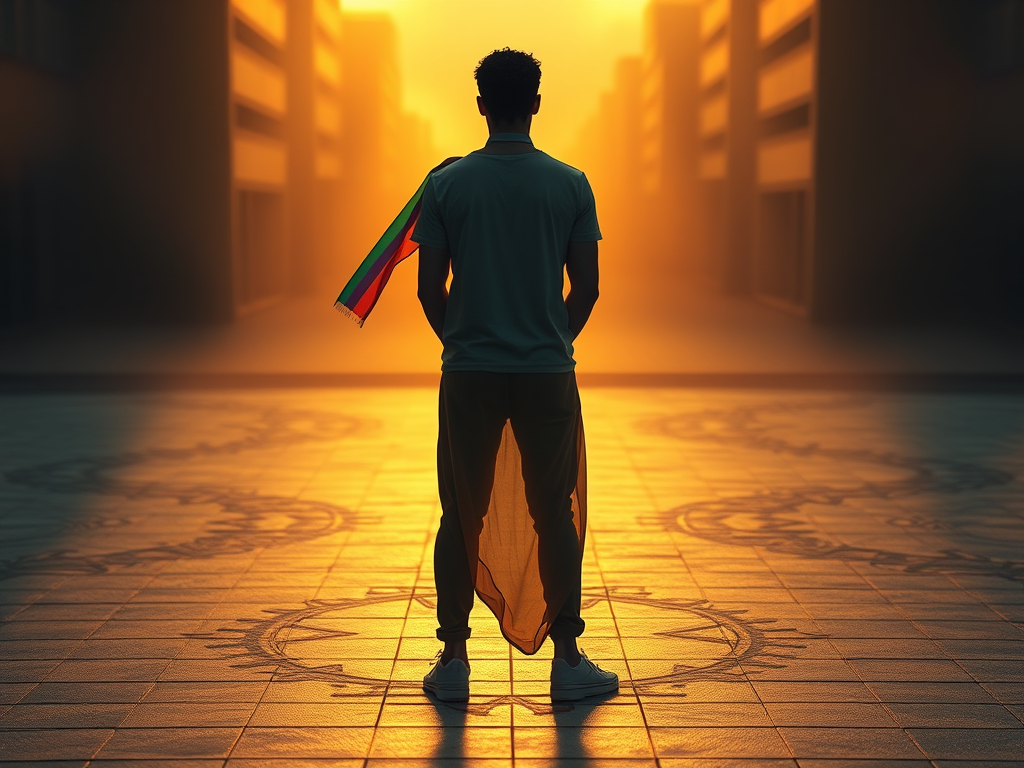

Being queer and Arab American means navigating intersecting marginalizations that few people understand. You’re too queer for your Arab community and too Arab for many LGBTQIA+ spaces. Your identity isn’t additive—it’s exponentially more complex.
This is what it’s like living at the intersection.
Double Closets
Many Arab American LGBTQIA+ people live in multiple closets simultaneously:
- Out to American friends but not family
- Out online but not in person
- Out in some family circles but not others
- Out to siblings but not parents
- Out professionally but not personally
Each closet requires different performance. You monitor your pronouns, your social media, your friends, your interests. You calculate risk constantly: Who can know? What’s safe to share? What’s the cost of visibility?
Some Arab American LGBTQIA+ people never come out to family, choosing distance over confrontation. Others come out and face rejection, disownment, or violence. Still others find surprising acceptance from family members who love them more than they fear community judgment.
There’s no roadmap. Every family is different. Every community is different. The risks are real and the stakes are high.
Religious and Cultural Stigma
Many Arab cultures stigmatize homosexuality, often conflating cultural tradition with religious mandate. Islam, Christianity, and Judaism all have conservative interpretations that condemn same-sex relationships. Liberal interpretations exist too, but they’re often drowned out by louder conservative voices.
Arab American LGBTQIA+ people navigate this by:
- Finding affirming religious communities and interpretations
- Leaving religion entirely
- Maintaining personal faith while rejecting institutional homophobia
- Compartmentalizing sexuality and spirituality
- Fighting to reform religious communities from within
But religious rejection from your own community hits different than American homophobia. It’s not just strangers—it’s imams who knew you as a child, Sunday school teachers who watched you grow up, family friends who now won’t make eye contact.
Family Dynamics and Honor
Arab culture often emphasizes family honor and community reputation. When your identity threatens that honor, you become the problem.
Parents worry:
- What will extended family say?
- What will the community think?
- How will this affect your siblings’ marriage prospects?
- Are they failures as parents?
These concerns aren’t abstract. In tight-knit Arab American communities, reputation matters. Parents face real social consequences when their children deviate from expectations.
This creates impossible situations: Come out and damage your family’s standing. Stay closeted and suffocate. Move away and lose connection to culture and community. Each option carries enormous cost.
Chosen Family vs. Blood Family
Many Arab American LGBTQIA+ people build chosen families when blood families reject them. Friends become siblings. Queer community becomes home. Chosen family provides acceptance that biological family withholds.
But chosen family can’t fully replace what’s lost:
- Cultural connection maintained through family
- Language practice with native speakers
- Traditional celebrations and rituals
- Intergenerational wisdom
- Belonging to something bigger than yourself
You gain freedom and authenticity while losing heritage and community. It’s not a fair trade—it’s a forced choice.
White LGBTQIA+ Spaces
Mainstream LGBTQIA+ spaces are often white-dominated and don’t understand intersectional identity. Arab American LGBTQIA+ people face:
- Islamophobia and racism within LGBTQIA+ communities
- Fetishization of Arab bodies and exotic othering
- Pressure to choose identity—are you queer first or Arab first?
- Ignorance about Arab cultures beyond stereotypes
- Assumptions that all Arab families are extremely homophobic
- Lack of cultural competency from LGBTQIA+ organizations
Pride events that ignore Palestinian and Arab LGBTQIA+ people. White LGBTQIA+ people using “cultural oppression” as an excuse for anti-Arab racism.
You’re searching for community while finding more marginalization.
Arab LGBTQIA+ Communities
Arab American LGBTQIA+ people are building their own spaces:
- Online communities where they can be fully themselves
- Support groups for queer Arabs navigating family and identity
- Cultural events that center both Arab and LGBTQIA+ identity
- Advocacy organizations fighting for Arab LGBTQIA+ rights
These spaces provide what mainstream communities can’t: understanding of cultural specificity, shared language (literal and figurative), and solidarity rooted in similar experiences.
But these communities are small and often fragmented across cities, making in-person connection difficult.
Dating and Relationships
Arab American LGBTQIA+ people face unique dating challenges:
Within Arab communities: Very few openly queer Arabs to date, most relationships staying hidden.
In broader LGBTQIA+ communities: Fetishization, stereotypes, and racism from potential partners.
With non-Arab partners: Having to explain your entire cultural context, facing family rejection of your partner, navigating cultural differences in how you express love and commitment.
Marriage: If you want legal recognition, you might lose family entirely. If you want family involvement, you might stay closeted or enter a hetero marriage.
Mental Health Crisis
Arab American LGBTQIA+ people face disproportionate mental health challenges:
- Higher rates of depression and anxiety
- Increased suicide risk
- Complex trauma from family rejection
- Internalized homophobia/transphobia from cultural messages
- Identity conflict
Yet accessing mental health support means:
- Finding culturally and LGBTQIA+ competent therapists (rare)
- Affording therapy (often not covered by family insurance you’re no longer on)
- Overcoming both Arab and LGBTQIA+ stigma around mental health
Many suffer in silence rather than seek help.
Trans Arab American Experiences
Trans Arab Americans face even more specific challenges:
- Accessing gender-affirming care while maintaining family connections
- Navigating gender norms in Arab culture that differ from American ones
- Explaining trans identity to family with no cultural framework for it
- Physical safety risks in both Arab and American spaces
- Legal name changes that out you to family
- Loss of cultural community when family rejects you
Trans Arab American women face particular violence. Trans Arab American men navigate complex masculinity expectations from multiple cultures.
Success Stories Exist
Not all Arab families reject their LGBTQIA+ children. Some surprise you:
- Parents who struggle initially but come around
- Siblings who become fierce advocates
- Extended family who prioritize love over tradition
- Communities that evolve toward acceptance
These stories deserve celebration. They prove that Arab culture isn’t inherently homophobic—cultural interpretation is mutable and progress is possible.
Strategies for Survival
Arab American LGBTQIA+ people develop strategies:
Financial independence: Can’t be disowned if you’re already independent.
Geographic distance: Living far from family provides breathing room.
Selective disclosure: Some family members know, others don’t.
Building community: Finding others who share your intersections.
Cultural preservation: Maintaining Arab identity through food, language, art—on your own terms.
Advocacy: Fighting for change so future generations have easier paths.
What You Deserve
If you’re a queer Arab American:
You deserve to exist fully. Not in pieces, not in closets, not in conditional acceptance.
Your identity is not a contradiction. Being Arab and queer isn’t impossible—it’s your lived reality.
You don’t owe anyone performance. Not straight-passing. Not “not that gay.” Not cultural purity to prove you’re Arab enough.
Your family’s rejection isn’t your failure. Their inability to accept you is their limitation, not your flaw.
You can love your culture while rejecting homophobia. Critical love is still love.
You’re not alone. Even when you’re the only queer Arab person you know, you’re part of a larger community.
Being queer and Arab American in 2026 means refusing the forced choice between identities. It means holding all your truth simultaneously, even when others can’t handle it.
You’re not asking permission to exist. You’re demanding recognition. That’s revolutionary.
Keep existing. Keep insisting. Keep building the world where young queer Arab kids don’t have to choose between their identities.
You’re changing the future by living your present authentically. That matters more than you know.
Keep reading: The Erasure of Arab History in American Education · Sephardic and Mizrahi Jews: Even More Complicated Whiteness · Arab Americans: Too White to Be a Minority, Too Brown to Be Safe
If you’re struggling, you don’t have to carry it alone. In the U.S., call or text 988 to reach the Suicide & Crisis Lifeline any time (press 2 for Spanish), text HOME to 741741 for the Crisis Text Line, or, for LGBTQ+ young people, contact The Trevor Project. If you’re in immediate danger, call 911.