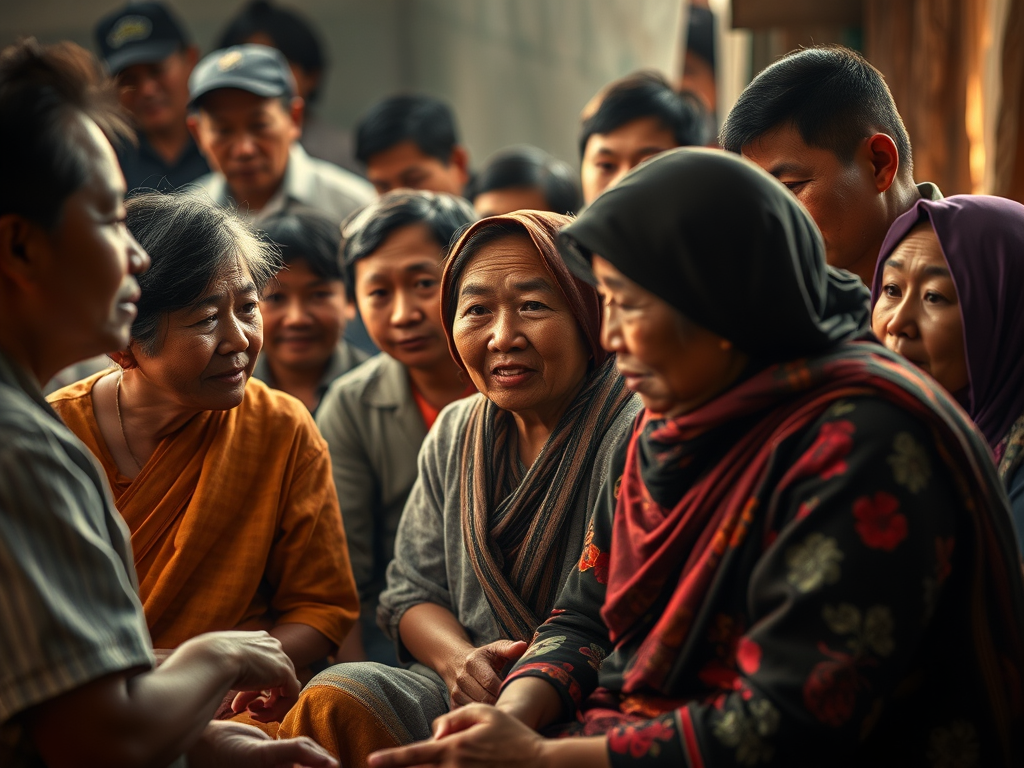

When people think “Asian American,” they rarely think Vietnamese, Cambodian, Laotian, Hmong, or Thai. We’re the invisible Asians—excluded from the model minority narrative but still lumped in with it when convenient.
Our communities came to the U.S. as refugees, fleeing wars the United States was deeply involved in. We arrived with nothing, faced discrimination and poverty, and built lives from scratch. But our stories don’t fit the neat “successful Asian” stereotype, so they get ignored.
It’s time to change that.
Refugee Roots
Most Southeast Asian Americans didn’t choose to come here. We were displaced by war—specifically, the Vietnam War and the Secret Wars in Laos and Cambodia. When Saigon fell in 1975, hundreds of thousands of Vietnamese refugees fled. Cambodians escaped the Khmer Rouge genocide. Laotians and Hmong people, who had fought alongside the U.S., became targets and had to run for their lives.
We didn’t arrive with degrees and capital like some other immigrant groups. We arrived in refugee camps, traumatized, grieving, and broke. That’s not a minor detail—it’s the foundation of our experience in America.
The Economic Reality
While the median household income for all Asian Americans is often cited as higher than the national average, Southeast Asian Americans tell a different story. Cambodian, Laotian, and Hmong households have poverty rates that exceed the national average.
Why? Because we started from zero. Because many of our parents and grandparents couldn’t speak English and worked grueling, low-wage jobs to survive. Because the trauma of war and displacement doesn’t just disappear when you cross a border.
We’re not failing the model minority myth. The myth was never designed to include us in the first place.
Educational Gaps
The model minority stereotype assumes all Asian American students are high achievers. But Southeast Asian students have some of the lowest college enrollment and graduation rates among Asian ethnic groups.
This isn’t about intelligence or work ethic. It’s about resources. Many of our families don’t have the cultural capital to navigate the American education system. Our parents didn’t go to college—they were too busy surviving. We don’t have access to expensive test prep or private tutors. We’re working jobs to help support our families while trying to stay in school.
And when educators assume we’re fine because we’re “Asian,” we don’t get the support we need.
Intergenerational Trauma
Surviving genocide, war, and displacement doesn’t just affect one generation—it echoes through families. Our parents and grandparents carry trauma they rarely talk about. Mental health stigma runs deep, and seeking help is often seen as weakness or shame.
That trauma shows up in our communities as high rates of depression, anxiety, PTSD, and substance abuse. It shows up in tense family dynamics, where parents who survived unimaginable horror struggle to connect with children growing up in relative safety.
Healing requires acknowledging what was lost and what was endured. It requires resources, culturally competent mental health support, and community care—all of which are in short supply.
Criminalization and the School-to-Prison Pipeline
Southeast Asian Americans, particularly Cambodians and Laotians, have some of the highest deportation rates of any Asian group. Many arrived as young children, grew up in under-resourced neighborhoods, got caught up in the criminal justice system, and are now being deported to countries they barely remember.
The pipeline from poverty to incarceration to deportation is real. It’s a direct result of the conditions our families were placed in when we arrived as refugees, combined with a system that criminalizes survival.
Language and Cultural Preservation
Many of our languages are at risk of disappearing. Younger generations grow up speaking English, and without formal education in our native languages, the connection to our heritage weakens.
This isn’t just about nostalgia—it’s about identity. Language carries culture, history, and values. Losing it means losing a piece of who we are. Community-led efforts to teach Khmer, Lao, Hmong, and Vietnamese are vital, but they’re underfunded and often overlooked.
What We Need
We need visibility. When people talk about AAPI issues, Southeast Asian experiences need to be part of the conversation—not an afterthought.
We need disaggregated data. Stop lumping us in with East and South Asians. Our challenges are different, and they deserve specific attention.
We need resources. Mental health services, educational support, job training, and community programs designed for refugee communities.
We need to tell our own stories. No more letting others define us. No more being erased from the narrative.
Our Strength
Despite everything—war, displacement, poverty, discrimination—our communities are here. We’re raising families, starting businesses, creating art, and building futures. We’re resilient not because we had to be, but because we chose to be.
Southeast Asian Americans deserve recognition, respect, and resources. We’re not a footnote in the AAPI story—we’re a central chapter. And we’re not going anywhere.
Keep reading: Pacific Islander Identity and Colonial Erasure · South Asian Americans and the Desi Diaspora · Filipino American History and Cultural Pride