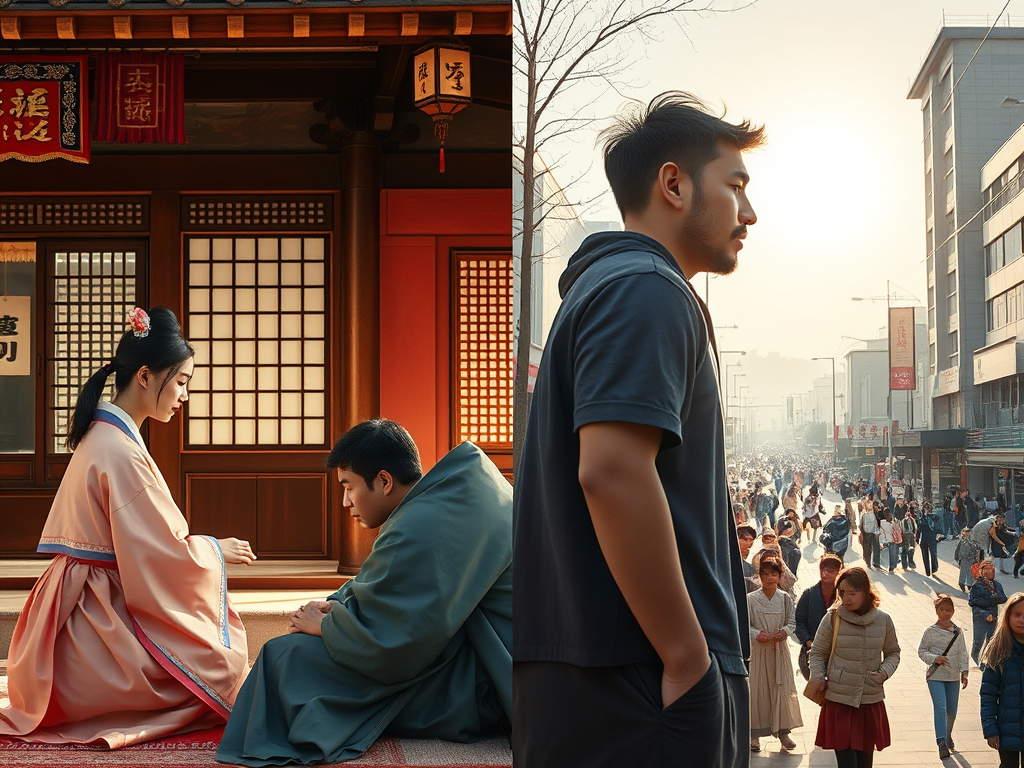

Korean Americans navigate a unique cultural tension: honoring deeply rooted traditions while adapting to a rapidly modernizing world. We’re children of immigrants who came seeking opportunity, but we’re also inheritors of a culture shaped by colonization, war, and resilience.
Balancing Korean identity with American identity isn’t about choosing one over the other—it’s about forging something new entirely.
Immigration and the American Dream
The majority of Korean Americans arrived after the Immigration and Nationality Act of 1965, which lifted racist quotas and allowed skilled workers and families to immigrate. Many came seeking economic opportunity and better education for their children.
The 1980s and 1990s saw a surge in Korean immigration, driven in part by political instability and economic challenges in South Korea. Korean immigrants opened small businesses—grocery stores, dry cleaners, restaurants—and worked relentlessly to establish themselves.
But the American Dream came with a cost. Long hours, financial strain, and the stress of navigating a new country took their toll. And despite their hard work, Korean business owners often faced discrimination and violence, most notably during the 1992 Los Angeles riots.
The LA Riots and Community Trauma
The 1992 LA riots left deep scars on the Korean American community. Korean-owned businesses in South Central LA were targeted and destroyed. The police didn’t show up to protect them. The media portrayed them as outsiders, greedy shop owners who didn’t care about Black customers.
The reality was more complicated. Korean immigrants, many of whom were struggling themselves, were caught in the crossfire of systemic racism and economic disinvestment that harmed both Black and Korean communities. Instead of building solidarity, the system pitted them against each other.
The trauma of the riots still lingers. It’s a reminder that hard work and sacrifice don’t guarantee safety or acceptance in America.
Language and Generational Divides
Korean is a complex language, and many second-generation Korean Americans struggle to speak it fluently. Parents speak Korean at home, but kids respond in English. Over time, the language barrier becomes a cultural barrier.
This creates tension. Parents feel like their children are losing touch with Korean culture. Kids feel like they’re not Korean enough for Korea and not American enough for America. The term “1.5 generation” refers to those who immigrated as children—caught between two worlds, fully belonging to neither.
Language loss isn’t just about communication. It’s about connection—to family, to history, to identity.
Filial Piety and Expectations
Korean culture places immense value on filial piety—the idea that children owe respect, obedience, and care to their parents. This isn’t just a nice tradition; it’s a deeply ingrained expectation.
For Korean American kids, this means pressure to succeed academically, pursue stable careers (preferably as doctors, lawyers, or engineers), and prioritize family over individual desires. Failure isn’t just personal—it’s a betrayal of the sacrifices parents made.
This pressure creates mental health struggles, but seeking help is stigmatized. Therapy is seen as airing family business to outsiders. Depression and anxiety are dismissed as weakness.
The result? A lot of Korean Americans silently struggling, trying to meet impossible expectations while losing themselves in the process.
The Influence of K-Pop and Korean Media
The global rise of K-pop, K-dramas, and Korean cinema has reshaped how Korean Americans relate to their heritage. For younger generations, Korean culture isn’t just what their parents taught them—it’s global, cool, and accessible.
BTS, Blackpink, Squid Game, Parasite—Korean media is everywhere, and it’s giving Korean Americans a new sense of pride. But it’s also complicated. Some feel like their culture is being commodified, turned into a trend rather than a lived experience.
Still, the visibility is powerful. It’s easier to be proud of your heritage when the world recognizes its value.
Navigating Identity
Korean Americans often feel like they’re not Korean enough for Korea and not American enough for America. In Korea, they’re seen as foreigners—their accents give them away, their mannerisms mark them as different. In America, they’re perpetual foreigners no matter how many generations their family has been here.
This in-between space can feel isolating, but it’s also where new identities are forged. Korean Americans are creating a culture that blends the best of both worlds while rejecting the pressures of each.
Building Community
Korean churches have long been the center of Korean American community life. They provide more than spiritual guidance—they offer social support, networking, and a place to connect with others who share the same cultural background.
But younger Korean Americans are expanding beyond traditional institutions. They’re creating spaces online, in art, in activism. They’re redefining what it means to be Korean American on their own terms.
The Future
Korean American identity isn’t static. It’s evolving, adapting, and resisting easy categorization. We honor tradition without being bound by it. We embrace modernity without losing our roots.
We’re not trying to be perfect Koreans or perfect Americans. We’re forging something new, something authentic to our experience. And that’s enough.