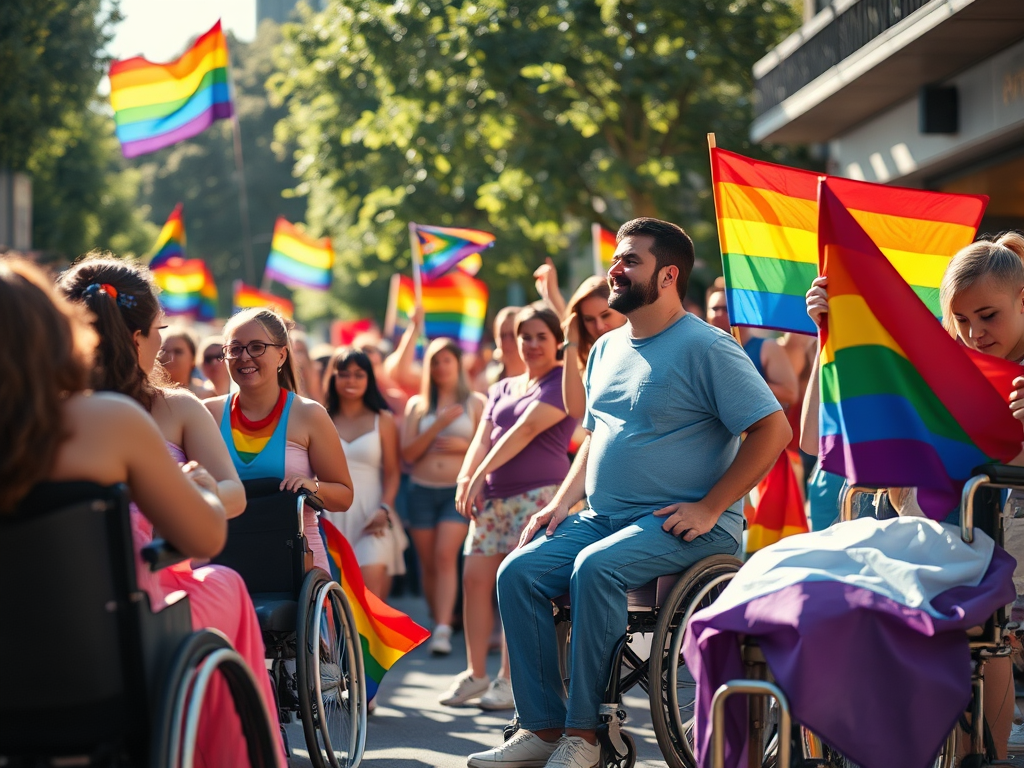

When Pride celebrations focus on able-bodied experiences, they erase disabled LGBTQIA+ people who’ve been part of the movement since the beginning. When disability justice movements center heteronormative perspectives, they marginalize disabled queer people. Meanwhile, disabled LGBTQIA+ folks navigate intersections that both communities ignore: inaccessible Pride events, assumptions that disabled people are asexual, medical systems that pathologize both disability and queerness, and social structures that treat disabled queer people as double deviants. Here’s what gets forgotten when Pride doesn’t center disability justice.
Double Marginalization
Disabled LGBTQIA+ people face compounding discrimination that neither disability rights movements nor LGBTQIA+ organizations adequately address. Disability communities often assume heterosexuality as default while failing to create accessible LGBTQIA+ programming. LGBTQIA+ spaces prioritize able-bodied experiences while treating disability as an afterthought or barrier to participation.
This double marginalization means disabled queer people lack community infrastructure that serves their full identities. Disability support groups may not be safe spaces to discuss queerness. LGBTQIA+ organizations may not be accessible to disabled people. Dating communities built for LGBTQIA+ people rarely consider disability. Disabled LGBTQIA+ people constantly navigate spaces designed without them in mind.
The result is isolation that compounds mental health challenges, limits social support, and makes it harder to build community. When you don’t fit fully into either disability or LGBTQIA+ spaces, finding belonging requires extra work—building your own community, educating both movements, and advocating for intersectional approaches that rarely exist.
Pride Events That Exclude
Most Pride events are physically inaccessible to disabled people. Parades happen on uneven streets without accessible viewing areas. Venues lack wheelchair ramps or accessible bathrooms. Events feature loud music and flashing lights with no sensory-friendly accommodations. Programming doesn’t include ASL interpreters or captioning.
When disabled LGBTQIA+ people raise accessibility concerns, they’re told to be grateful for whatever inclusion exists. Event organizers treat accessibility as expensive extras rather than civil rights requirements. The message is clear: Pride isn’t for disabled queer people unless we can access events designed for able-bodied people.
Even digital Pride spaces often fail at accessibility. Websites lack screen reader compatibility. Videos don’t include captions. Images don’t have alt text. Online events don’t consider people with different disability-related needs for participation.
This inaccessibility is particularly cruel given that disabled LGBTQIA+ people have always been part of the movement. But when Pride events exclude disabled people, they erase this history while claiming to celebrate liberation.
The Asexuality Assumption
Society assumes disabled people are either asexual or hypersexual—never just sexual beings with varied desires and identities. Disabled LGBTQIA+ people face assumptions that they couldn’t possibly have sexual orientations or gender identities because disability supposedly negates sexuality.
This assumption manifests in patronizing attitudes, medical professionals dismissing disabled people’s sexual health needs, and social dynamics that treat disabled queer people as non-sexual. If you’re disabled and express queer desire, people question whether you’re “really” LGBTQIA+ or just confused because of disability.
Disabled LGBTQIA+ people also navigate medical systems that pathologize both disability and queerness. Doctors view disability as tragedy requiring fixing and queerness as disorder requiring treatment. When you’re both disabled and queer, medical professionals may blame your queerness on disability or vice versa.
This medical discrimination affects healthcare access profoundly. Disabled trans people face particular barriers to gender-affirming care—providers deny hormones or surgery based on disability, claiming disabled people can’t consent or that transition would be too risky. These denials treat disabled people as incapable of making decisions about their own bodies and gender identities.
Dating and Relationships
Disabled LGBTQIA+ people face discrimination in dating that compounds ableism with homophobia or transphobia. On dating apps, disclosing disability often leads to immediate rejection. People treat disability as dealbreaker regardless of attraction or compatibility.
Disabled queer people also navigate assumptions about sexual capability and desirability. Society treats disabled bodies as inherently unattractive and incapable of sexual activity. When you’re disabled and queer, finding partners who don’t fetishize disability or treat you as charity case becomes exponentially harder.
For disabled trans people, dating includes additional layers. Disclosing both trans identity and disability means multiple potential rejection points. Navigating physical intimacy when you have disability-related needs requires partners willing to communicate and adapt—something many people aren’t prepared for.
Disabled LGBTQIA+ people also face violence in relationships at higher rates than non-disabled LGBTQIA+ people. Partners may use disability to control or isolate them. They may threaten to withhold disability-related care. They may use society’s ableism to make disabled partners feel like they can’t do better.
Intersecting Oppressions
Disabled LGBTQIA+ people of color face triple marginalization—racism, ableism, and homophobia/transphobia simultaneously. Black disabled queer people navigate assumptions about criminality, hypersexuality, and incompetence. Indigenous disabled LGBTQIA+ people deal with colonialism’s impacts on both disability support and LGBTQIA+ acceptance.
Immigrant disabled LGBTQIA+ people may face deportation if disability makes them “public charges.” Poor disabled queer people navigate inadequate social services while facing discrimination in both disability and LGBTQIA+ spaces. Each intersecting identity adds layers of marginalization that compound rather than simply adding together.
For neurodivergent LGBTQIA+ people, intersections include specific challenges around communication, social expectations, and pathologization. Autistic queer people may face assumptions that they’re confused about gender or sexuality. People with intellectual disabilities face assumptions they can’t understand their own identities.
Disability Justice Is Queer Justice
The disability justice movement was founded in part by disabled queer people of color who recognized that single-issue movements failed to address intersecting oppressions. Disability justice centers the leadership of disabled people who experience multiple marginalizations—disabled LGBTQIA+ people, disabled people of color, disabled people in poverty.
This framework recognizes that liberation requires addressing all forms of oppression simultaneously. You can’t achieve disability justice without addressing homophobia and transphobia. You can’t achieve queer liberation without centering disabled LGBTQIA+ people’s experiences and needs.
Disability justice principles apply to LGBTQIA+ organizing: leadership by the most marginalized, recognition of wholeness (not fixing), sustainability over burnout culture, collective access and collective liberation, cross-movement solidarity, and commitment to cross-disability justice rather than privileging some disabilities over others.
What Accessibility Actually Requires
Making Pride truly accessible means physical accessibility—ramps, accessible bathrooms, seating areas, accessible routes to and through venues. It means sensory accessibility—quiet spaces, lighting accommodations, advance information about sensory environment.
It means communication accessibility—ASL interpreters, captioning, alternative formats for written materials, image descriptions. It means economic accessibility—free or affordable events, transportation support, stipends for disabled LGBTQIA+ speakers and performers.
It means attitudinal accessibility—training staff and volunteers on disability justice, challenging ableist assumptions, centering disabled LGBTQIA+ people’s experiences, and treating accessibility as right rather than accommodation or special favor.
Building Inclusive Community
Disabled LGBTQIA+ people are building the communities that mainstream movements fail to create. Organizations like Sins Invalid, Disability Justice Culture Club, and local disabled queer collectives create space where disability and queerness intersect without apology.
These spaces prove that disabled queer existence is valid, vibrant, and valuable. They challenge assumptions about disability and sexuality. They center disabled queer joy alongside disabled queer resistance. They create cultural productions—art, performance, writing—that celebrate disabled LGBTQIA+ experiences.
Online communities have been particularly important for disabled LGBTQIA+ people who face barriers to in-person participation. Social media enables connection across geographic distance and physical barriers. Digital spaces allow disabled queer people to find each other and build solidarity when local communities exclude them.
To Every Disabled LGBTQIA+ Person
Your queerness is real regardless of your disability. Your disability doesn’t make you confused, incapable, or less queer. You don’t need to overcome or minimize your disability to be part of LGBTQIA+ community.
You deserve Pride events that are accessible. You deserve LGBTQIA+ spaces where you don’t have to explain disability 101. You deserve relationships where partners respect both your disability and your queerness. You deserve healthcare that affirms both identities.
The spaces that exclude you are wrong—not you. The events that aren’t accessible are failing—you’re not failing by needing accessibility. The communities that don’t serve disabled LGBTQIA+ people are inadequate communities—your needs aren’t too much.
There are disabled LGBTQIA+ people building the futures we deserve. There are communities where you can show up fully as yourself. There are people who understand your experience without needing education. You’re not alone even when it feels that way.
Your disabled queer existence is resistance. Your demands for accessibility are liberation work. And your presence in LGBTQIA+ spaces—whether physical or digital—expands what Pride can mean. You belong here. You always have.