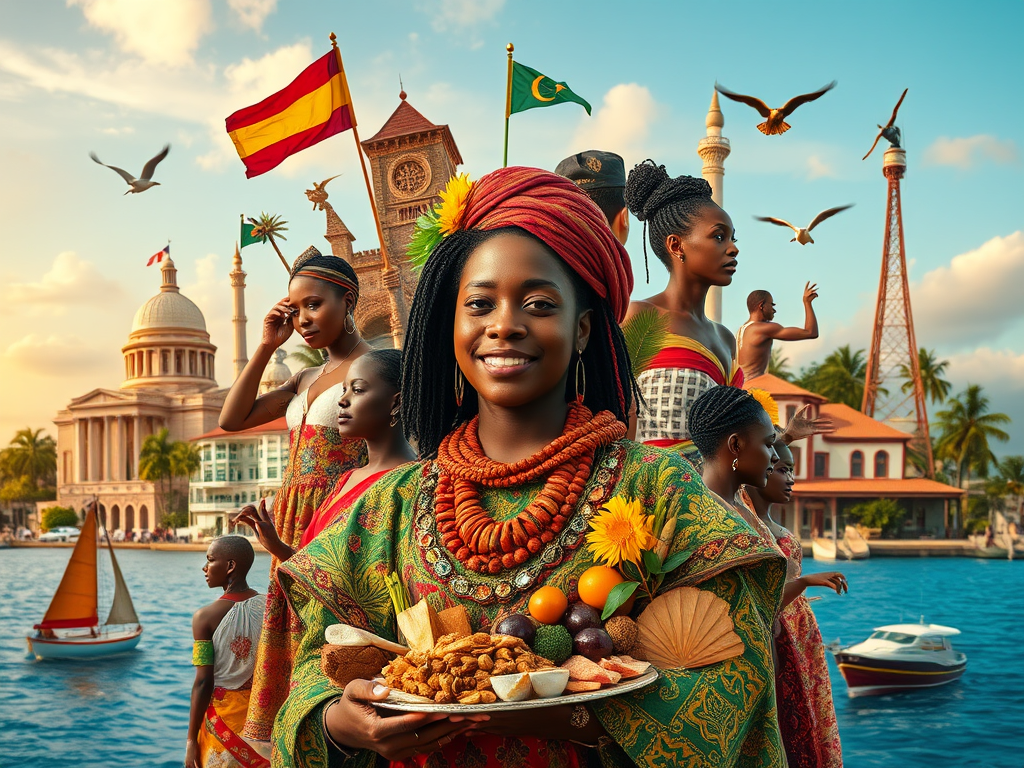

The Split Screen Life
You know that feeling when you’re living in two worlds at once, and neither one fully gets you? That’s the Caribbean American experience in a nutshell. You’re too American for the islands and too island for America, caught in a cultural split screen that nobody prepared you for.
Caribbean diaspora in the U.S. represents over 4 million people, but we’re often invisible in conversations about Black America, Latinx communities, and immigrant experiences. We’re the hyphen that everyone forgets—Caribbean-American, West Indian-American, a whole universe of islands compressed into categories that don’t quite fit.
More Than a Vacation Destination
When most Americans think Caribbean, they think beaches, resorts, and Bob Marley. They don’t think about the accountant from Trinidad, the nurse from Jamaica, or the engineer from Haiti navigating corporate America while code-switching between patois and professional English.
Caribbean identity carries the weight of colonial history, the complexity of post-independence politics, and the richness of African, Indigenous, Indian, Chinese, and European cultural fusion. We’re not a monolith—a Dominican’s experience differs from a Barbadian’s, which differs from a Haitian’s, which differs from a Guyanese person’s experience. Even within islands, class, color, and culture create distinct realities.
The Model Minority They Forgot
Here’s what often gets left out of the conversation: Caribbean immigrants to the U.S. have historically been positioned as the “good” Black immigrants, used to shame African Americans for not “pulling themselves up” the same way. This narrative is toxic, divisive, and completely ignores the selection bias of immigration—people who can afford to migrate often come with education, resources, or family networks.
Caribbean Americans navigate a specific kind of racism that acknowledges our work ethic and education while simultaneously exoticizing our accents, fetishizing our culture, and expecting us to distance ourselves from African Americans. The system loves a good wedge, and immigrant success stories make perfect tools for division.
Language as Identity Marker
Your accent tells a story. Whether it’s Jamaican patois, Haitian Creole, Trinidad English, or any of the dozens of linguistic variations across the islands, Caribbean speech patterns mark us as different. In professional spaces, we learn to flatten our vowels, soften our consonants, and code-switch into American Standard English. At home, at family gatherings, at Caribbean restaurants, the real language comes back.
This linguistic code-switching isn’t just about being understood—it’s about being taken seriously, about not being dismissed as “foreign” or “unprofessional,” about navigating spaces that see your accent as charming at parties but problematic in boardrooms.
Food, Family, and Fierce Pride
Caribbean culture survives through food. Every pot of curry goat, every plate of jerk chicken, every helping of roti or rice and peas carries the weight of home. Caribbean parents don’t play about food—you eat what’s cooked, you respect the kitchen, and you learn that meals are about connection, not just consumption.
Family structures in Caribbean culture tend toward extended networks. Auntie isn’t just your mother’s sister—she’s any older woman in your community who has authority to correct you. Respect for elders isn’t optional. This collectivist approach often clashes with American individualism, creating tension for second-generation Caribbean Americans trying to honor family expectations while building independent lives.
The Second Generation Struggle
If you’re first generation born in America to Caribbean parents, you know the particular challenge of being “not enough” for either culture. You’re not American enough for your classmates (especially if you spent summers “back home”), and you’re not Caribbean enough for your cousins on the islands who see you as soft, spoiled, or disconnected.
Second-generation Caribbean Americans build hybrid identities—Caribbean food with American pop culture, Caribbean values with American career ambitions, Caribbean family structures with American relationship models. This isn’t dilution; it’s evolution. You’re creating something new while honoring something old.
Claiming Your Identity
Caribbean identity in America exists in the margins of multiple narratives. We’re Black, but our Blackness is questioned. We’re immigrants, but our immigration story gets erased. We’re American, but always with an asterisk.
The work is to claim all of it—the islands you came from, the country you live in, the culture you’re creating in between. You don’t have to choose. Your identity isn’t a zero-sum game where claiming one part means losing another.
Caribbean diaspora isn’t about nostalgia for a place left behind. It’s about building community in the present, maintaining connections across oceans, and raising children who understand that their roots run deep even when they’re planted in different soil. You’re not lost between worlds—you’re creating a bridge between them.
Keep reading: Afro-Caribbean Culture and Its Global Influence · Caribbean Immigration Waves and Community Building · Caribbean Carnival: Culture, Resistance, and Joy