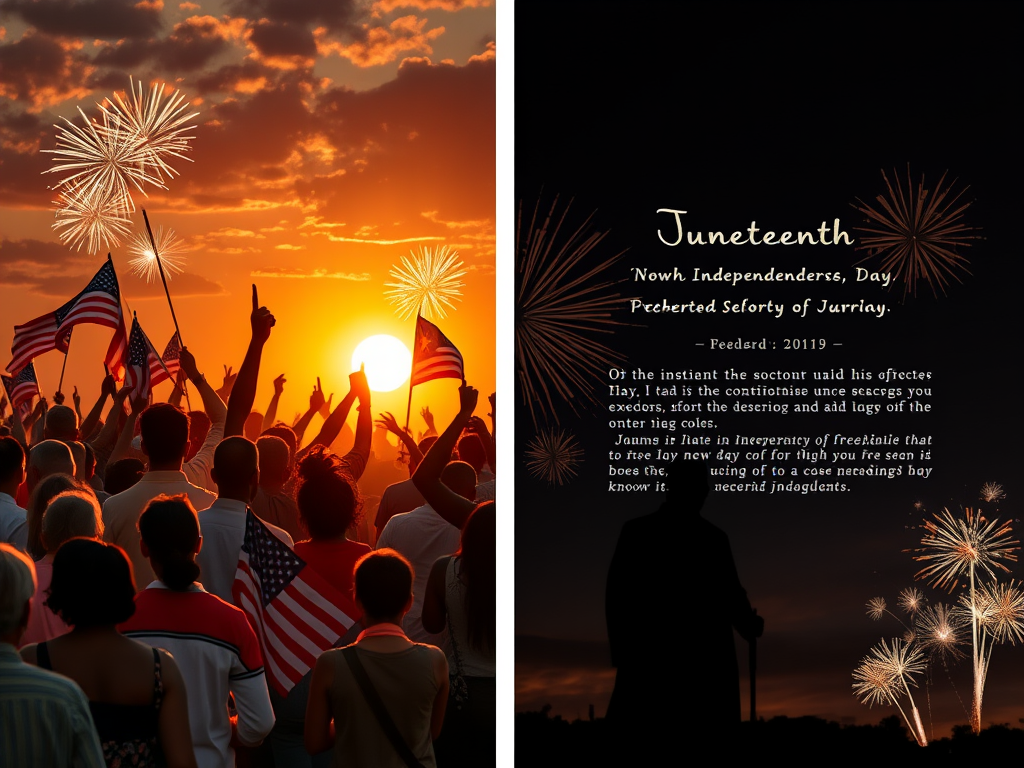

Every Fourth of July, America celebrates independence with fireworks, flags, and declarations of freedom. On June 19th, Juneteenth commemorates the day enslaved people in Texas finally learned they were free—two and a half years after the Emancipation Proclamation.
Two freedom celebrations. Two very different meanings.
What Happened on July 4, 1776?
The Declaration of Independence proclaimed that “all men are created equal” and have the right to “life, liberty, and the pursuit of happiness.”
Thomas Jefferson wrote those words. Thomas Jefferson owned over 600 enslaved people in his lifetime and fathered children with Sally Hemings, an enslaved woman who couldn’t consent because she wasn’t free.
The Founding Fathers fought for independence from British rule while denying freedom to the people they enslaved. They built a nation on stolen land using stolen labor and called it liberty.
Independence Day celebrates freedom—for white men who owned property.
What Happened on June 19, 1865?
Union General Gordon Granger arrived in Galveston, Texas, and read General Order No. 3: “The people of Texas are informed that, in accordance with a proclamation from the Executive of the United States, all slaves are free.”
This was two and a half years after Lincoln signed the Emancipation Proclamation on January 1, 1863. Why the delay? Texas was remote, the Confederacy didn’t enforce Union orders, and slaveholders had no incentive to tell enslaved people they were free.
Some slaveholders moved to Texas specifically to keep their slaves away from Union forces. Others waited until after the harvest to “inform” enslaved people they could leave.
Even after Juneteenth, freedom was precarious. Slavery was replaced with sharecropping, convict leasing, and Black Codes—new systems to re-enslave Black people economically and legally.
But on June 19th, enslaved people learned they were supposed to be free. And they celebrated.
The Symbolism Gap
Independence Day celebrates theoretical freedom—written in documents but never fully realized for everyone.
Juneteenth celebrates actual freedom—delayed, incomplete, but fought for and finally acknowledged.
One is a promise that was never kept. The other is a promise that’s still being fought for.
Frederick Douglass on the Fourth of July
In 1852, Frederick Douglass gave a speech titled “What to the Slave Is the Fourth of July?” He said:
“What, to the American slave, is your 4th of July? I answer: a day that reveals to him, more than all other days in the year, the gross injustice and cruelty to which he is the constant victim. To him, your celebration is a sham; your boasted liberty, an unholy license; your national greatness, swelling vanity; your sounds of rejoicing are empty and heartless; your denunciations of tyrants, brass fronted impudence; your shouts of liberty and equality, hollow mockery.”
That was 1852. It’s 2026. And much of what Douglass said still applies.
Why Juneteenth Matters Now
Juneteenth only became a federal holiday in 2021—156 years after the event it commemorates. That delay is symbolic. America celebrates white freedom immediately and Black freedom reluctantly.
Juneteenth matters because it’s a reminder that Black freedom in America has always been conditional, delayed, and fought for—not granted.
It’s also a celebration of resilience. Enslaved people didn’t wait for permission to claim their humanity. After Juneteenth, they built schools, churches, businesses, and families. They survived Reconstruction, Jim Crow, lynching, and mass incarceration.
Juneteenth is a celebration of survival and an acknowledgment that the fight isn’t over.
The Commercialization Problem
Now that Juneteenth is a federal holiday, corporations slap red, black, and green on their branding and sell “Juneteenth merchandise” while doing nothing to address systemic racism.
The same companies that donate to politicians who suppress Black votes will post Juneteenth graphics. The same brands that underpay Black workers will host Juneteenth sales.
Performative celebration without substantive change is just another form of exploitation.
What Real Celebration Looks Like
Real Juneteenth celebration means:
- Supporting Black-owned businesses, not just on Juneteenth but year-round
- Attending local Juneteenth events organized by Black communities
- Learning the full history—not the sanitized version
- Advocating for reparations, voting rights, and policies that advance Black freedom
- Having honest conversations about what freedom actually means when Black people still face police violence, mass incarceration, and economic inequality
Celebration without action is performance.
Rethinking Independence Day
Some Black families don’t celebrate the Fourth of July. Some celebrate it with an asterisk—acknowledging the hypocrisy but still participating in the picnics and fireworks.
There’s no right answer. But there is a truth: Independence Day wasn’t meant for us. The freedom it celebrates excluded us.
That doesn’t mean Black people can’t claim it. But it does mean we should recognize what we’re claiming—and what’s still owed.
Freedom Is Still Incomplete
Juneteenth marks the end of chattel slavery, but not the end of systemic oppression. Black people still aren’t free when:
- We’re disproportionately incarcerated for the same crimes white people commit
- Our votes are suppressed through gerrymandering and voter ID laws
- Our neighborhoods are over-policed and under-resourced
- Our children attend underfunded schools
- Our wealth is a fraction of white wealth due to centuries of theft and exclusion
Juneteenth is a celebration and a reminder: freedom delayed is freedom incomplete.
Moving Forward
Celebrate Juneteenth. Learn its history. Support Black freedom movements. Demand reparations.
And on the Fourth of July, ask yourself: Whose independence? Whose freedom? And what are you willing to do to make those promises real for everyone?
Because until Black people are free, nobody’s free.
That’s the lesson of both holidays.
Keep reading: Bayard Rustin: The Gay Man Behind the March on Washington · Martin Luther King Jr. Day: Beyond the Quotes-His Radical Legacy · MLK’s Economic Justice Vision That History Forgot