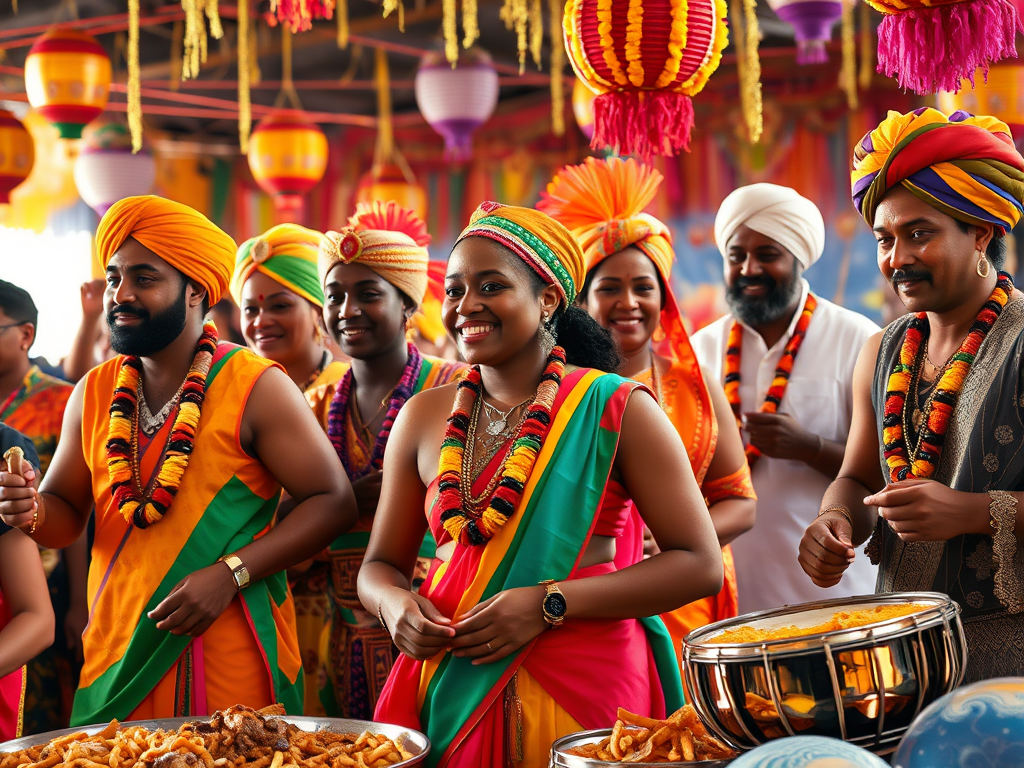

The Minority Within the Minority
Indo-Caribbean people exist in an identity space that most Americans don’t even know exists. We’re South Asian by ancestry, Caribbean by culture, and American by circumstance—and we’re largely invisible in conversations about any of these identities. We’re too Indian for Caribbean spaces, too Caribbean for South Asian spaces, and completely absent from most American understandings of who counts as “minority.”
Let’s change that.
The History Nobody Teaches
After slavery ended in the Caribbean in the 1830s, British colonizers needed new cheap labor for sugar plantations. They created the indentureship system, bringing over 500,000 Indians to Caribbean colonies between 1838 and 1917, primarily to Trinidad, Guyana, Suriname, and Jamaica. This wasn’t voluntary migration—it was exploitation with a different name.
Indentured laborers faced brutal conditions, family separation, and broken promises of return passage to India. Many never returned. They built new lives in the Caribbean, maintaining Indian traditions while adapting to Caribbean reality. Over generations, they created something distinct—Indo-Caribbean culture that’s neither fully Indian nor fully Caribbean, but uniquely both.
This history gets erased from narratives about both South Asian diaspora and Caribbean identity. Indo-Caribbean people are footnotes in history books that should feature us prominently.
Cultural Fusion and Tension
Indo-Caribbean culture represents one of the world’s most interesting cultural fusions. Hindu and Muslim religious practices adapted to Caribbean context. Indian languages mixed with Caribbean English and Creole. Indian food traditions blended with Caribbean ingredients and African cooking techniques. Bollywood music merged with calypso and soca.
But this fusion came with tension. In many Caribbean nations, relations between Afro-Caribbean and Indo-Caribbean communities have been complex, sometimes competitive, occasionally hostile. Colonial divide-and-rule strategies pit communities against each other—a strategy that continues affecting Caribbean politics and society today.
Indo-Caribbean people navigated racism from European colonizers while also working through complicated relationships with Afro-Caribbean communities. This created specific challenges around colorism, economic competition, and political representation that still play out today.
The American Context: Double Invisibility
In America, Indo-Caribbean people face unique invisibility. We’re often mistaken for South Asian Indians and face the same model minority pressures, assumptions about tech careers, and stereotypes about accents and arranged marriages. But our Caribbean culture—our food, our music, our speech patterns—doesn’t match South Asian American experiences.
At the same time, in Caribbean American spaces, Indo-Caribbean people are sometimes treated as less authentically Caribbean, as if Caribbean identity belongs exclusively to Afro-Caribbean people. This erasure ignores our history, our contributions, and our legitimate claim to Caribbean identity.
The result? Indo-Caribbean Americans code-switch constantly, emphasizing different parts of our identity depending on context, never fully fitting anywhere, always explaining ourselves.
Language and Identity
Many Indo-Caribbean people speak Hindi, Bhojpuri, or other Indian languages mixed with Caribbean English/Creole. This linguistic fusion marks us as distinct from both South Asian Indians and other Caribbean people. Our accents are Caribbean, but our languages carry Indian words and phrases that have been preserved, adapted, or transformed over generations.
Second-generation Indo-Caribbean Americans often lose these languages, creating generational disconnection. Grandparents speak Hindi, parents speak English with Caribbean accents, children speak American English—each generation losing linguistic threads that tie us to history.
Food as Cultural Preservation
Indo-Caribbean food is its own cuisine—distinct from South Asian and from other Caribbean cooking. Doubles (curried chickpeas in fried bread), roti and curry, pholourie (fried split pea snacks)—these foods are Indo-Caribbean staples that most Americans have never heard of.
When people discover Trinidad roti or Guyanese curry, they’re often surprised it exists—as if Caribbean and Indian cuisines couldn’t possibly combine. But they have, creating something delicious and distinct that deserves recognition as its own culinary tradition.
Religion and Tradition
Indo-Caribbean people maintained Hindu and Muslim religious traditions across generations, but these traditions evolved in Caribbean context. Phagwah (Holi), Divali, Eid—all celebrated with Caribbean flavor. Temples and mosques in Trinidad, Guyana, and Suriname look different from those in India, incorporating Caribbean architectural elements and community practices.
For Indo-Caribbean Americans, maintaining these religious traditions means navigating both South Asian American religious communities (where we’re sometimes seen as less authentic) and general American society (where our practices are exoticized or misunderstood).
Political Power and Representation
In Trinidad and Guyana, Indo-Caribbean people make up significant portions of the population and have held political power. But this political visibility in the Caribbean hasn’t translated to visibility in American contexts. Indo-Caribbean Americans are largely absent from conversations about South Asian American political power or Caribbean American political organizing.
We need our own political analysis, our own organizing strategies, and our own platforms that center our specific experiences rather than being footnotes in other communities’ narratives.
Claiming Visibility
The work for Indo-Caribbean people is refusing invisibility. It’s insisting that Caribbean identity includes us, that South Asian diaspora includes us, that American minority experiences include our specific reality. It’s writing our own histories instead of waiting for others to acknowledge us.
It’s also building solidarity without erasing differences. We can honor connections to both Afro-Caribbean and South Asian communities while insisting that Indo-Caribbean identity is distinct and valuable on its own terms.
You’re not confused about your identity—you’re carrying multiple legitimate identities simultaneously. That’s not weakness or contradiction; that’s the reality of diaspora, colonialism, and cultural fusion. Indo-Caribbean identity exists. It matters. And it’s time for American culture to recognize that.
Keep reading: Caribbean Cuisine as Cultural Preservation · Music from the Islands: Reggae, Soca, and Beyond · Caribbean LGBTQIA+ Experiences