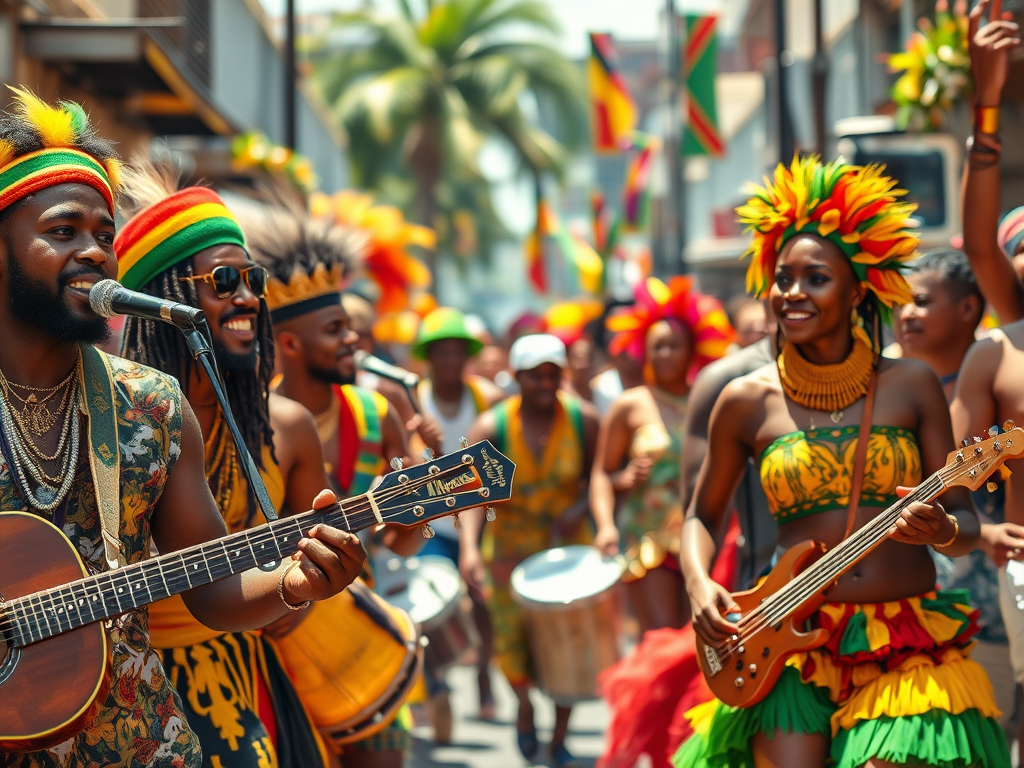

The Soundtrack of Resistance
Caribbean music hasn’t just influenced global culture—it’s fundamentally shaped it, providing rhythms, genres, and frameworks that define modern music. From reggae to dancehall, from soca to calypso, from kompa to zouk, Caribbean sounds carry the weight of resistance while delivering joy, offering political critique wrapped in basslines that make you move.
This is music as revolution, sound as strategy, rhythm as resistance.
Reggae: One Love, One Heart, One Struggle
Reggae emerged from Jamaica in the late 1960s, blending American R&B, Jamaican ska and rocksteady, and Rastafari philosophy into something entirely new. Bob Marley became reggae’s global ambassador, but the genre’s roots run deeper than one icon.
Reggae carried messages of liberation, anti-colonialism, African unity, and spiritual resistance. Songs like “Get Up, Stand Up” and “Redemption Song” weren’t just music—they were calls to action, revolutionary manifestos set to basslines. Reggae spoke truth to power when doing so was dangerous, giving voice to the marginalized and oppressed worldwide.
The genre’s international reach proved Caribbean culture could dominate global consciousness. Reggae influenced punk in Britain, hip-hop in America, and resistance movements in Africa. It showed that Black Jamaican working-class culture could speak universal truths while remaining uncompromisingly Caribbean.
Dancehall: The People’s Music
Dancehall evolved from reggae in the late 1970s, faster, harder, more explicit, less concerned with international palatability. While reggae crossed over to white audiences, dancehall remained defiantly Black, working-class, and raw.
Dancehall gets dismissed as violent or vulgar, but that’s missing the point. It’s music from and for people society tries to silence—poor Jamaicans, ghetto youth, people living realities that respectable society wants to ignore. Dancehall talks about street life, sexual pleasure, political grievances, and everyday survival without softening edges for mainstream consumption.
Artists like Shabba Ranks, Beenie Man, Bounty Killer, and Vybz Kartel created music that refused to make poverty palatable or violence acceptable while honestly representing ghetto realities. Modern artists like Spice and Skillibeng continue evolving the genre while maintaining its working-class roots.
Soca: Carnival Sound
Soca emerged in Trinidad in the 1970s, created by Lord Shorty (later Ras Shorty I) as a faster, more energetic evolution of calypso. Soca is carnival music—designed for dancing in the streets, for playing mas, for celebration that refuses to be contained.
But soca isn’t just party music. Like calypso before it, soca carries social commentary, political critique, and cultural pride. Artists like Machel Montano, Bunji Garlin, and Destra Garcia create soca that makes you wine while thinking about society, dance while considering politics.
The energy of soca—the tempo, the bass, the call-and-response between performer and audience—reflects Caribbean philosophy that joy and resistance aren’t opposites. You can critique systems while celebrating culture, fight oppression while dancing in the streets.
Calypso: Singing Truth
Calypso predates soca, emerging from Trinidad in the early 20th century as musical commentary on society and politics. Calypso singers (calypsonians) were historians, journalists, and activists, documenting events and critiquing power through song.
Colonial authorities recognized calypso’s power and tried to censor it. They couldn’t. Calypsonians developed coded language, clever wordplay, and metaphors that allowed them to criticize authorities while maintaining plausible deniability.
Calypso Rose, Mighty Sparrow, Lord Kitchener—these weren’t just entertainers; they were cultural warriors using music as weapon. Their songs documented Caribbean history from Caribbean perspectives, challenging colonial narratives and asserting Caribbean dignity.
Kompa, Zouk, and French Caribbean Sounds
The French Caribbean developed its own distinct musical traditions. Haiti’s kompa and the French Antilles’ zouk represent different approaches to Caribbean rhythm, incorporating African percussion, French melodic traditions, and Caribbean creativity.
These genres remain less known internationally than reggae or soca, reflecting how English-language cultural products dominate global markets. But kompa and zouk are no less sophisticated, no less influential in their regions, no less worthy of recognition.
Steelpan: The Instrument of Innovation
Trinidad’s steelpan deserves special recognition—the only acoustic instrument invented in the 20th century, created from discarded oil barrels by people colonizers tried to silence. When colonial authorities banned African drums, Trinidadians created music from industrial waste.
Steelpan started as ghetto innovation and became national symbol. Steelpan orchestras now perform classical music alongside calypso and soca, proving Caribbean people can master any musical form while maintaining our distinct cultural voice.
Hip-Hop’s Caribbean Roots
Hip-hop emerged from Caribbean immigrant communities in the Bronx. DJ Kool Herc, the founding father, brought Jamaican sound system culture to New York—the breaks, the toasting, the party format. Early hip-hop was Caribbean innovation in American context.
This connection gets erased in hip-hop histories that want American origins without immigrant influences. But the truth is clear: hip-hop’s foundation is Caribbean, built by Jamaican and Puerto Rican youth creating something new from Caribbean traditions.
The Economics of Cultural Theft
Caribbean music shaped global culture, but Caribbean artists rarely see proportionate profits. Major labels, streaming services, and concert promoters extract value while paying Caribbean artists less than they’d pay American or European performers.
When Drake or Rihanna incorporate Caribbean sounds into their music, it’s called “tropical” or “island influences”—sanitized language that extracts rhythm without crediting source. Caribbean artists deserve credit, compensation, and control over how our music is used and represented.
Protecting Musical Heritage
The work ahead is ensuring Caribbean music remains economically and culturally controlled by Caribbean people. That means supporting Caribbean artists directly, buying music instead of just streaming, attending live shows, and demanding fair representation in music industry spaces.
It also means teaching younger generations Caribbean music history—not just the hits, but the context, the politics, the resistance embedded in rhythm. When you understand that reggae is revolution and soca is resistance, music becomes more than entertainment; it becomes inheritance.
Caribbean music gave the world its rhythm. The world owes us more than dance moves—it owes us respect, recognition, and payment.