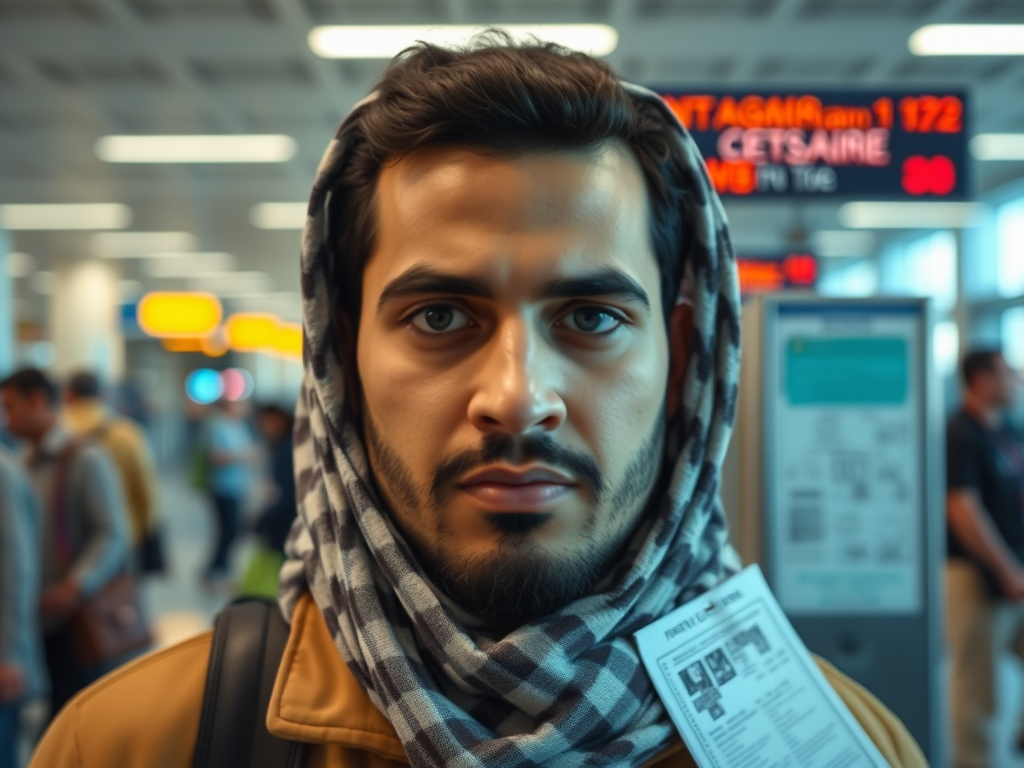

For decades, you filled out your census form and checked the box marked “White.” Two weeks later, you’re at the airport, and TSA pulls you aside for additional screening—for the third time this month. This is the cognitive dissonance at the heart of being Middle Eastern or North African (MENA) in America: officially white, practically anything but.
The disconnect between how the government classifies MENA people and how they’re actually treated reveals fundamental problems with American racial categories. It shows that whiteness isn’t just about skin color or census boxes—it’s about who feels safe, who gets trusted, who belongs. And by that measure, MENA Americans know exactly where they stand.
The Historical Accident
The classification of MENA people as white is essentially a historical accident, codified through court cases in the early 1900s when immigrants from the Middle East and North Africa argued for white status to access naturalization and avoid harsh immigration restrictions.
These legal victories established MENA people as officially white. The 1977 Office of Management and Budget Directive 15, which standardized federal racial categories, maintained this classification. It groups together people with origins in Europe, the Middle East, and North Africa as “White.”
On paper, someone from Norway and someone from Yemen are the same race. Someone from Ireland and someone from Iraq check the same census box. This would be laughable if it weren’t so consequential.
The Post-9/11 Rupture
Everything changed after September 11, 2001. Suddenly, looking Middle Eastern or North African became dangerous. Even though MENA people were officially white, the public perception shifted overnight to view them as threatening, foreign, and Other.
The government led this shift. The National Security Entry-Exit Registration System (NSEERS) specifically targeted men from predominantly Muslim MENA countries, requiring them to register with authorities regardless of immigration status or citizenship. The FBI conducted mass interviews of Arab and Muslim Americans. Mosques came under surveillance. People were detained without charges.
None of this cared about census classifications. If you looked Middle Eastern or had an Arab or Persian name, you were subject to heightened scrutiny. Your legal whiteness offered no protection whatsoever.
The TSA Experience
Airport security has become the most visible daily reminder that MENA Americans’ official whiteness is meaningless. The “random” additional screening that happens repeatedly. The invasive questions about your name, your family, your travel history. The assumption that you might be dangerous.
MENA travelers have countless stories: being pulled aside every single time they fly, having their belongings extensively searched, being questioned about why they’re traveling to visit family, being asked about their religion or political beliefs, missing flights because screening takes so long, having children as young as five subjected to pat-downs.
This isn’t paranoia. Civil rights complaints, lawsuits, and traveler surveys have long documented that people with Arab, Persian, or Muslim-sounding names are pulled aside far more often. The system treats them differently.
And every time this happens, the message is clear: you’re not white in any way that actually matters. You’re not trusted. You’re not safe. You’re not really American.
The No-Fly List Problem
Perhaps nothing illustrates the gap between census classification and lived reality more than the No-Fly List. After 9/11, thousands of people—many of them MENA Americans—found themselves unable to board flights with no explanation, no due process, and no recourse.
These were American citizens, people who checked the white box on forms, people who’d never been convicted of any crime. But their names, their backgrounds, their associations were enough to land them on a secret list that could devastate their lives.
Imagine trying to explain to a potential employer why you can’t travel for business. Imagine missing a parent’s funeral because you can’t fly. Imagine your child being flagged at age seven because they share a name with someone on a watch list.
Your census classification as white doesn’t help you fight the No-Fly List. It doesn’t protect you from suspicion. It doesn’t make you safe.
The Surveillance State
MENA communities, particularly Muslim MENA communities, have been subjected to surveillance that would be unthinkable for white communities. The NYPD’s Muslim Surveillance Program mapped Muslim communities, infiltrated mosques, and monitored student groups. The FBI ran informant-driven sting operations that critics and some judges have called entrapment. Immigration authorities targeted community organizations and charities.
This surveillance affects everyone in MENA communities, regardless of religion. Christian Arabs get swept up because they’re Arab. Secular Iranians get monitored because they’re from Iran. Coptic Egyptians face questions because they’re Egyptian.
Once again, the white census classification provides no protection. The surveillance doesn’t care what box you check—it cares about your ethnicity, your name, your community ties.
The Hate Crime Gap
Here’s a statistical problem created by classifying MENA people as white: hate crimes against them are often miscategorized or undercounted.
When a MENA person is assaulted because of their perceived ethnicity, how is it classified? Sometimes as a religious hate crime if they’re Muslim or appear Muslim. Sometimes as just assault. Rarely as a racially motivated hate crime because officially, they’re white.
This creates a data gap that makes it harder to track, address, and prevent violence against MENA communities. If the crimes don’t show up in statistics, policies don’t get made to address them. Resources don’t get allocated. Protection doesn’t get provided.
The Discrimination Double Standard
Employment discrimination against MENA people is real and measurable. Studies using identical resumes with different names show that applicants with Arab, Persian, or Muslim-sounding names receive fewer callbacks. People with Middle Eastern accents face workplace harassment. Visible markers like hijabs lead to fewer job offers.
But because MENA people are classified as white, this discrimination doesn’t trigger the same legal protections or institutional responses as discrimination against officially recognized minority groups. It doesn’t count in diversity initiatives. It doesn’t show up in discrimination statistics. It exists in a legal and institutional gray area.
Companies can tout their commitment to diversity while having zero MENA representation and facing no consequences because those individuals are counted as white.
The Medical Research Gap
Even medical research suffers from the white classification. MENA people are lumped with Europeans in medical studies, despite potentially having different genetic profiles, health risks, and treatment responses.
This matters for understanding disease prevalence, drug efficacy, and health outcomes. But if researchers can’t distinguish MENA participants from other white participants, gaps in knowledge persist.
Some MENA people have genetic predispositions to certain conditions—like Familial Mediterranean Fever in certain Middle Eastern populations. But research into these conditions is complicated by the inability to properly identify and study MENA populations in existing data.
The Census Mobilization
For over two decades, MENA communities have been fighting for a separate MENA census category. The argument is straightforward: if you want to understand population demographics, address discrimination, allocate resources, and create inclusive policies, you need accurate data. And you can’t have accurate data when diverse populations are misclassified.
A MENA category would make invisible populations visible. It would allow tracking of discrimination, hate crimes, and health disparities. It would enable targeted outreach and resource allocation. It would acknowledge that MENA Americans exist as a distinct group with specific needs and experiences.
The Census Bureau has considered adding a MENA category multiple times. Testing showed it would improve response rates and data accuracy. Community organizations strongly supported it. Everything pointed toward implementation.
Then political resistance intervened. There were concerns about backlash, about making MENA people easier to target, about the politics of identity categories. The Trump administration ultimately rejected the MENA category for the 2020 census. In 2024, after years of advocacy, the federal government finally approved a MENA category for federal data, but as of 2026 its rollout remains uncertain.
The Fear of Visibility
This brings up a painful paradox: some MENA Americans oppose the census category because they’re afraid increased visibility will lead to increased discrimination. If the government officially recognizes MENA as a category, could that category be used for surveillance, travel restrictions, or even internment?
This isn’t paranoid—it’s based on recent history. The same government that implemented NSEERS, that conducted mass surveillance of Muslim communities, that issued the 2017 travel ban, widely called the “Muslim Ban”, that separated families at borders—that government would control the use of MENA data.
So some MENA Americans prefer to remain invisible, hoping their white classification will provide some protection even though they know it doesn’t in practice. Better to be misclassified than officially categorized in ways that could be weaponized against you.
The Younger Generation’s Response
Younger MENA Americans, particularly those born after 9/11, are taking a different approach. Many reject the white label entirely, identifying as Brown, as people of color, or using their specific ethnic identities (Arab, Persian, Turkish, Amazigh, etc.).
They’re building coalitions with other minority communities, recognizing shared experiences of racialization and discrimination. They’re demanding representation in diversity initiatives even if they’re not officially counted. They’re creating spaces where MENA identity is acknowledged and centered.
This generational shift reflects a broader understanding that census categories don’t define reality. If you’re treated as a minority, if you experience discrimination, if you navigate identity in ways that don’t align with whiteness—then that’s your lived truth regardless of what boxes exist on forms.
What Needs to Change
The disconnect between census classification and lived reality can’t continue indefinitely. MENA Americans deserve recognition for who they are and for what they experience.
This means creating a MENA census category that acknowledges their distinct identity. It means collecting accurate data on discrimination and hate crimes. It means including MENA Americans in diversity and inclusion initiatives. It means providing resources and protections based on actual experiences, not arbitrary classifications.
It also means having honest conversations about what whiteness means in America. If MENA people are white but don’t experience whiteness—if they’re white to the census but brown to TSA—then clearly whiteness is about more than ancestry or skin color. It’s about power, safety, belonging, and who gets to be fully American.
The Bottom Line
The census calls MENA Americans white because of legal decisions made over a century ago. TSA doesn’t treat them as white because post-9/11 America decided they’re threats. This gap reveals that racial categories are social constructions designed to serve specific purposes—and those purposes don’t always align with people’s lived experiences.
MENA Americans know they’re white on paper and brown in practice. They know their census classification protects nothing and changes nothing about how they’re actually treated. They know that when policies get made, when suspicions get raised, when discrimination happens, no one cares what box they checked.
This isn’t sustainable. You can’t build an inclusive, equitable society when entire populations fall through categorical cracks. You can’t address discrimination you refuse to see. You can’t protect people whose identities you refuse to acknowledge.
MENA Americans deserve better than being white to the census and suspect to everyone else. They deserve recognition, respect, and categories that actually reflect who they are.
Until that happens, they’ll keep navigating a world where they’re told they’re one thing while being treated as another. Where they check white boxes and get pulled aside for screening. Where they’re officially part of the majority while experiencing life as a targeted minority.
That’s the MENA paradox. And it’s long past time we acknowledged it, addressed it, and created systems that see people for who they actually are rather than forcing them into categories that never fit in the first place.
Keep reading: When DEI Initiatives Leave You Out: White Ethnicity and Inclusion · Can White People Experience Cultural Appropriation? · White Passing MENA People: Too Light to Belong Anywhere