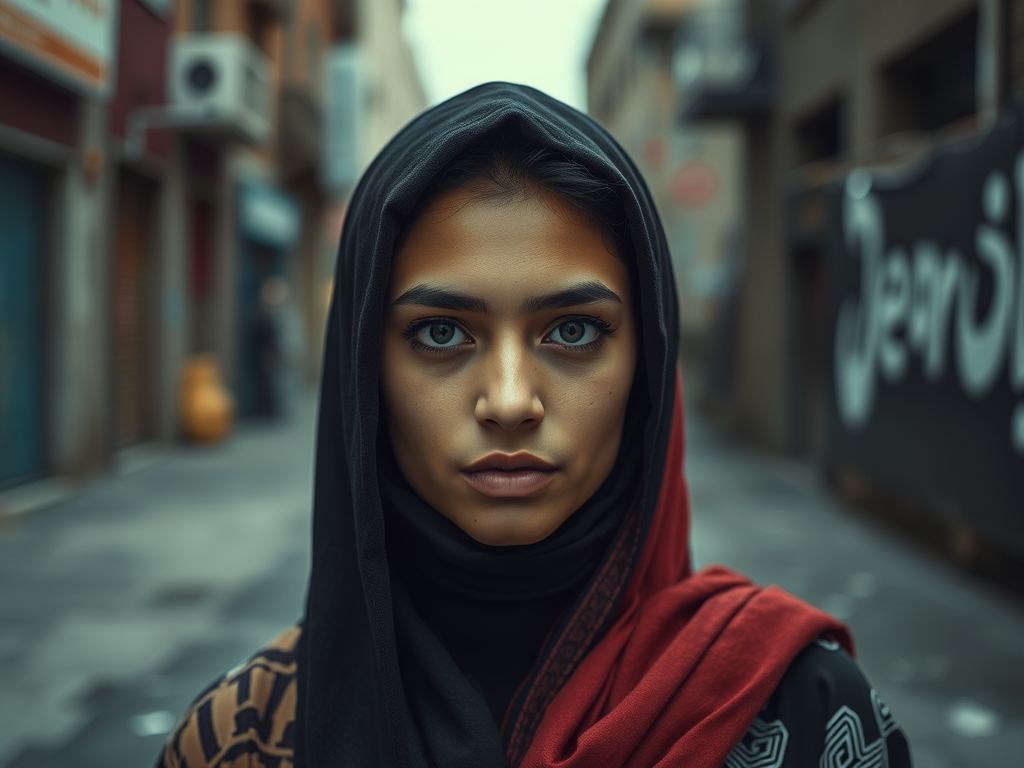

You learn early that your identity comes with a caveat. You’re Arab, but not that Arab. Persian, but you could pass for Italian. Armenian, but people assume you’re white until you say your last name. You exist in a strange liminal space where you’re too light to claim marginalization but too ethnic to fully assimilate.
Welcome to the white-passing MENA experience, where your identity is always qualified, always questioned, always conditional.
The Checkbox That Erases You
For decades, it started with forms. Every school application, job application, census form, medical intake asked the same question: “What is your race/ethnicity?” And there, under the options, you saw it: White (including Middle Eastern or North African).
That parenthetical is doing a lot of work. It’s simultaneously acknowledging that MENA people exist and completely erasing them by lumping them into a category they don’t fit. You’re white for data purposes, but everyone knows you’re not white-white. You’re white when it’s convenient for the system and ethnic when it’s convenient for discrimination.
The result is statistical invisibility. The FBI didn’t even track anti-Arab hate crimes as their own category until 2015. Employment discrimination disappears into the white majority. Educational disparities become invisible. Health outcome differences go uncounted.
That’s finally starting to change. In 2024, the federal government approved a separate Middle Eastern or North African (MENA) category for federal forms, including the census. But agencies have until 2029 to adopt it, and as of 2026 the rollout is still uncertain. Until it’s fully in place, most forms will keep counting you as white.
You exist, but the data says you don’t.
The Privilege That Isn’t
Yes, there’s privilege in being able to pass as white. You’re less likely to be followed in stores, more likely to get job interviews with an anglicized name, less likely to face certain forms of street harassment. This is real and it matters.
But that privilege is conditional and precarious. It lasts exactly as long as people don’t know your background. The moment your name comes up, the moment someone asks where you’re “really from,” the moment you mention your culture or religion—the shield drops. You go from white-adjacent to suspicious, from American to foreigner, from insider to other.
This is different from the experience of someone who is unambiguously white and whose ethnicity—Irish, Polish, Italian—carries no contemporary social penalty. When you’re white-passing MENA, your acceptance is always provisional.
The Identity Gaslighting
Perhaps the cruelest part is how your own experience gets denied from all sides. People of color may see your light skin and assume you have white privilege without understanding the discrimination you face. White people may exoticize you when it’s convenient but expect you to assimilate when it’s not.
You’re told you’re not a real minority because you’re white on paper. But you’re also told you’re not really American because of your name, your culture, your family’s history. You exist in a permanent state of not-enough: not ethnic enough to claim marginalization, not white enough to escape it.
Someone makes a “joke” about your people being terrorists, and when you object, you’re told you’re being too sensitive. Someone assumes you’re Italian or Greek, and when you correct them, they look uncomfortable—as if you’ve revealed something embarrassing. Someone asks you to translate something “in Muslim” and you don’t know whether to laugh or cry.
This is your reality, but it doesn’t fit anyone’s frameworks for understanding identity and discrimination. So it gets dismissed, minimized, or ignored.
Post-9/11 MENA
If you’re old enough to remember September 11, 2001, you remember when everything changed. Suddenly being Arab or Muslim or just having a name that sounded like it might be Arab became dangerous. Hate crimes spiked. Discrimination became normalized. Surveillance became routine.
And here’s the thing: your white-passing privilege didn’t protect you. Because discrimination against MENA people isn’t primarily about skin color—it’s about perceived foreignness, perceived religion, perceived threat. You could be light-skinned as snow, but if your name is Mohamed or Yasmin, if you speak Arabic, if you wear a hijab or have a beard, you became a target.
The irony is that this discrimination happened to people the government classified as white. White people were being hate-crimed for being the wrong kind of white. White people were being pulled aside for “random” TSA screenings every single time they flew. White people were being told to go back to their country.
But because the data classified MENA people as white, none of this registered as discrimination against a minority group. It was just… what? Isolated incidents? Personal conflicts? Certainly not systemic bias.
The Culture You Can’t Claim
There’s a special kind of pain in being disconnected from your culture because claiming it marks you as other. Maybe your parents anglicized your name to protect you. Maybe you were discouraged from speaking Arabic at home because it drew negative attention. Maybe you learned to downplay your background, to pass, to assimilate.
And now you’re an adult trying to reconnect with a heritage you were taught to hide. You want to learn the language your grandparents spoke. You want to cook the food, practice the traditions, understand the history. But you also know that claiming your identity publicly comes with consequences.
So you exist in this strange split: privately ethnic, publicly passing. You code-switch not just in language but in entire identity. You become an expert at reading rooms, at knowing when it’s safe to be yourself and when you need to be the version of yourself that makes others comfortable.
The Representation Problem
Turn on the TV, open a book, scroll through social media—where are you? MENA representation is either nonexistent or horrifying. You’re terrorists, taxi drivers, belly dancers, or mystical side characters. You’re never just… people. You’re never the romantic lead, the brilliant scientist, the complex protagonist.
And when there is representation, it’s often by people who aren’t MENA at all. Hollywood casts white actors in MENA roles and darkens their skin. Publishers market books as “diverse” when the Arab character is a stereotype. Even in progressive spaces that celebrate diversity, MENA voices are afterthoughts.
You watch other communities fight for and win representation, and you’re happy for them. But you also wonder: when is it our turn? When do we get to see ourselves as fully human on screen, on page, in life?
The Political Homelessness
Politically, you don’t fit anywhere. Conservative spaces often harbor Islamophobia and anti-Arab sentiment. Progressive spaces preach inclusion but forget you exist. You’re not white enough for white identity politics and not “person of color” enough for POC spaces, even though you face racialization and discrimination.
During election seasons, politicians talk about “reaching out to minority communities” and they mean Black voters, Latinx voters, Asian voters. MENA voters are statistically invisible. Your issues—discrimination, surveillance, foreign policy that devastates your countries of origin—aren’t even on the agenda.
You’re politically homeless, too ethnic for one party and too statistically white for the other to bother courting.
Finding Community in the In-Between
So what do you do? You find each other. You build community in the margins, in the spaces between categories. You connect with other MENA people who understand the specific flavor of your experience. You create your own representation when the world won’t give it to you. You push to make sure the new MENA category actually reaches the forms that count you as who you are.
And you get comfortable with complexity. You learn to hold multiple truths: Yes, you have light-skin privilege in many contexts. And yes, you face discrimination based on ethnicity and perceived religion. You benefit from being white-passing. And you’re erased by being classified as white. Both things are true.
You stop waiting for permission to claim your identity. You stop apologizing for being too much of one thing and not enough of another. You exist in the in-between because that’s where you’ve always been, and maybe that’s okay.
You’re Not Imagining It
If you’re reading this and recognizing yourself, know this: you’re not imagining the discrimination you face. You’re not being too sensitive. Your identity is real, your experiences are valid, and your existence matters even if the data says you don’t exist.
You are too light to belong anywhere only in a system that refuses to see you. In reality, you belong everywhere you choose to be. Your lightness doesn’t make you less Arab, less Persian, less Armenian. Your ethnicity doesn’t make you less American. You’re not too anything. You’re exactly who you are.
And that’s enough. Even when the world says it isn’t.
The categories will catch up eventually. The data will change, the census will adjust, the frameworks will expand. But you don’t have to wait for systems to recognize you to know who you are.
You’re MENA. You’re here. And you’re not going anywhere.
Keep reading: Arab American Identity Beyond Stereotypes · The Diversity Within Arab America: Not a Monolith · Arab American Contributions to Science and Medicine