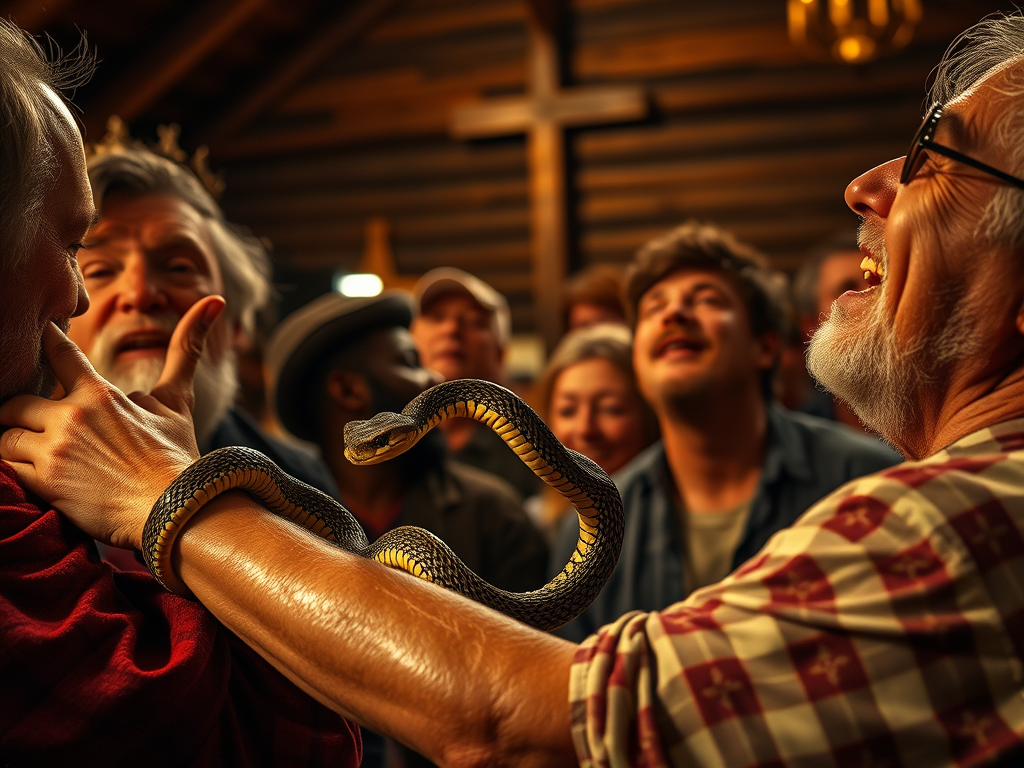

In the hills of West Virginia, Kentucky, Tennessee, and other Appalachian states, there exists a Christian tradition that most Americans either mock or fear: Pentecostalism with snake handling, speaking in tongues, foot washing, and ecstatic worship that looks nothing like the quiet, orderly services in suburban megachurches. (Snake handling gets the headlines, but only a small number of churches, estimated at around 100 to 125, still practice it.)
Most Appalachian Pentecostals are white, which should grant them majority status and all its privileges. But they’re also poor, rural, and practice a faith that marks them as Other in ways that transcend race. They experience a unique form of marginalization that combines class-based contempt, religious prejudice, and regional stereotyping—creating a minority experience within the white majority.
The Holiness Movement
To understand Appalachian Pentecostalism, you have to understand its roots in the Holiness movement of the late 19th century. This was a time when mainline Protestantism was becoming more liberal, more educated, and more aligned with middle-class respectability.
The Holiness movement rejected this trajectory. It emphasized personal religious experience, emotional worship, strict moral codes, and the possibility of sanctification—being made holy through divine intervention. It appealed particularly to poor and working-class people who felt excluded from respectable Protestantism.
In Appalachia, this movement took on distinctive characteristics. The region’s isolation, poverty, and independence fostered religious practices that emphasized direct divine encounter over institutional authority. If you couldn’t afford a seminary-trained preacher or a fancy church building, you relied on the Holy Spirit to move directly among believers.
This produced a form of Christianity that looks wild to outsiders: people speaking in tongues, being slain in the Spirit, handling poisonous snakes as a test of faith, drinking strychnine, and engaging in worship that’s loud, physical, and ecstatic.
Snake Handling and Stigma
Perhaps nothing defines Appalachian Pentecostalism—and marks it as Other—more than snake handling. Based on a literal reading of Mark 16:18 (“they shall take up serpents; and if they drink any deadly thing, it shall not hurt them”), some Appalachian Pentecostal churches incorporate handling poisonous snakes into their worship as a demonstration of faith.
To outsiders, this looks insane. National media covers snake-handling churches with a mixture of horror and fascination, treating believers like exotic specimens or reckless fools. When someone dies from a snake bite—and deaths have occurred—it’s treated as proof of dangerous stupidity rather than religious martyrdom.
But to believers, snake handling is about complete surrender to God’s will. It’s about trusting so fully that you’re willing to handle death and let God protect you. It’s the ultimate expression of faith over fear.
The stigma attached to snake handling extends to all Appalachian Pentecostals, even those who don’t handle snakes. They’re all painted with the same brush: backward, irrational, dangerous.
Class and Cultural Contempt
The religious othering of Appalachian Pentecostals is inseparable from class-based contempt for Appalachian people generally. Urban and educated Americans have long viewed Appalachia as backward, poor, ignorant, and worthy only of mockery or pity.
This contempt shows up in media representations—the “hillbilly” stereotype that portrays Appalachian people as toothless, uneducated, lazy, and possibly incestuous. It shows up in political discourse that dismisses Appalachian concerns and needs. It shows up in economic policies that have left the region impoverished and exploited.
Appalachian Pentecostals embody everything that educated America finds contemptible: they’re poor, they’re rural, they have thick accents, they didn’t go to college, and they practice a religion that seems primitive and embarrassing.
This creates a unique kind of marginalization. They’re white, so they don’t face racism. They’re Christian, so they’re not a religious minority in the traditional sense. But they’re othered in ways that feel just as excluding and dehumanizing.
The Respectability Problem
One of the challenges Appalachian Pentecostals face is the existence of respectable Pentecostalism. Churches like the Assemblies of God, while Pentecostal in theology, have become mainstream and middle-class. They’ve built large buildings, trained professional clergy, and made Pentecostalism acceptable to suburban America.
This respectable Pentecostalism allows educated Americans to say, “I’m not prejudiced against Pentecostals”—they just find Appalachian Pentecostalism specifically backward and wrong. The criticism isn’t about the core beliefs, it’s about the class markers: the way people dress, talk, worship, and express their faith.
This is class prejudice dressed up as religious or cultural critique. It’s saying that speaking in tongues is fine in a megachurch but weird in a small wooden church in rural Kentucky. It’s accepting Pentecostalism when practiced by people with college degrees but mocking it when practiced by coal miners and their families.
Education and Expertise
Mainstream American culture values educational credentials and expert knowledge. Appalachian Pentecostalism values direct divine revelation and personal religious experience over formal training.
Many Appalachian Pentecostal preachers have no seminary training. They’re called to ministry through religious experience, not academic preparation. They speak from inspiration, not from exegesis of ancient languages or theological scholarship.
To educated Americans, this looks like ignorance and dangerous anti-intellectualism. How can you trust religious leaders who haven’t studied theology? How can you base your faith on feelings and experiences rather than rational analysis?
But for Appalachian Pentecostals, this skepticism of expertise is both practical and theological. Practically, they can’t afford seminary. Theologically, they believe God can speak directly to anyone, regardless of education. The Holy Spirit doesn’t require a degree to move.
This creates a fundamental values clash. Appalachian Pentecostals are dismissed as ignorant by people who value education, while they view those educated critics as spiritually dead and overly reliant on human wisdom.
The Political Dimension
Appalachian Pentecostals are overwhelmingly politically conservative, which adds another layer to their othering in progressive and educated spaces. They’re anti-abortion, opposed to same-sex marriage, skeptical of evolution, and supportive of traditional gender roles.
In the eyes of coastal, educated, progressive America, this makes them not just backward but dangerous. They’re the people voting for candidates progressives despise, holding beliefs progressives find abhorrent, and resisting social changes progressives champion.
This political dimension means Appalachian Pentecostals get dismissed not just as uneducated or eccentric but as actively harmful. Their minority status within white Christianity doesn’t earn them sympathy from progressives who might otherwise care about marginalized groups—it earns them contempt.
Economic Exploitation and Abandonment
The marginalization of Appalachian Pentecostals can’t be separated from the economic exploitation of Appalachia. The region has been systematically exploited for its natural resources—coal, timber, natural gas—with profits extracted by outside corporations while residents remain in poverty.
When coal mining declined, the region was left with destroyed environments, collapsed economies, and few alternatives. Jobs disappeared. Young people left. Communities fell apart. Those who remained—including Appalachian Pentecostals—struggled with poverty, addiction, and lack of opportunity.
Their religious faith is often the one thing that provides meaning, community, and hope. The church becomes the social center, the support system, the place where people who have nothing else still have dignity and purpose.
Mocking their faith while ignoring their economic circumstances is a particular form of cruelty. It’s laughing at how people cope with suffering while doing nothing to address the suffering itself.
Health and Mortality
Appalachia faces severe health disparities. Rates of diabetes, heart disease, cancer, and opioid addiction are higher than national averages. Life expectancy is lower. Access to healthcare is limited.
Some of these health problems relate to poverty—poor nutrition, lack of preventive care, environmental degradation from mining. Some relate to despair—the opioid epidemic hit Appalachia particularly hard, devastating communities that already had little.
Appalachian Pentecostal churches have tried to respond to these crises with prayer, community support, and sometimes with skepticism of medical establishment solutions they can’t afford anyway. This gets dismissed as faith healing stupidity rather than recognized as communities doing what they can with limited resources.
When someone dies from refusing medical treatment in favor of prayer, it makes national news as an example of religious extremism. When someone dies because they couldn’t afford treatment or lived in a medical desert, it barely registers.
The Accent Marker
Appalachian accents are among the most stigmatized in America. They’re associated with ignorance, backwardness, and low intelligence regardless of the speaker’s actual education or capability.
Appalachian Pentecostals carry this accent, and it immediately marks them as Other. When they speak—in church, in public, in job interviews—they’re judged. People make assumptions about their intelligence, their beliefs, their worth.
This accent discrimination is a form of class-based and regional prejudice. It says that how you talk determines your value, that certain ways of speaking are inherently inferior, that you should be ashamed of how your family and community taught you to communicate.
The Stereotype Trap
Appalachian Pentecostals are caught in a stereotype trap. Media representations almost always portray them as either dangerous fanatics or pitiable fools. There’s no nuanced portrayal, no acknowledgment of complexity, no recognition of their full humanity.
When they’re shown handling snakes, it’s to mock or sensationalize. When they’re shown speaking in tongues, it’s to create spectacle. When they’re shown at all, they’re there to represent everything urban America thinks it’s superior to.
This affects how they’re treated in broader society. Employers don’t want to hire people associated with snake handlers. Educators dismiss students from Pentecostal backgrounds as unlikely to succeed. Social service providers approach them with condescension or fear.
Community Resilience
Despite—or because of—their marginalization, Appalachian Pentecostal communities demonstrate remarkable resilience. They take care of each other when nobody else will. They create meaning and purpose in circumstances that seem hopeless. They maintain dignity in the face of contempt.
Their churches provide food for hungry families, support for people struggling with addiction, companionship for the isolated, and hope for the despairing. They do this without government grants, foundation support, or recognition from broader society.
This resilience gets dismissed as clinging to false hope or refusing to face reality. But maybe it’s actually a model of how marginalized communities survive when dominant culture has abandoned them.
Moving Toward Understanding
Understanding Appalachian Pentecostals requires setting aside class prejudice, religious contempt, and regional stereotyping. It requires recognizing that being white doesn’t protect you from other forms of marginalization. It requires acknowledging that religious practices that seem strange to you might be deeply meaningful to others.
It also requires grappling with the economic and social abandonment of Appalachia. You can’t separate Appalachian Pentecostalism from the context of poverty, exploitation, and limited opportunities. Their faith isn’t ignorance—it’s a response to circumstances created by systems that educated critics benefit from.
Most importantly, it requires extending the same generosity you’d extend to other minority religious communities. If you can appreciate the cultural specificity of other faith traditions, you can extend that same appreciation to Appalachian Pentecostals—even if their practices make you uncomfortable.
They’re not asking to be saved or pitied. They’re not asking anyone to join their churches or adopt their beliefs. They’re asking for the basic dignity of being seen as fully human, of having their faith respected even if not understood, of being acknowledged as a legitimate minority community within white Christianity.
That shouldn’t be too much to ask.
Keep reading: Dust Bowl Migrants: The ‘Okies’ and Regional Discrimination · White Brazilians: Majority Appearance, Regional Minority · What If You’re White But Don’t Feel Like You Have a Culture?