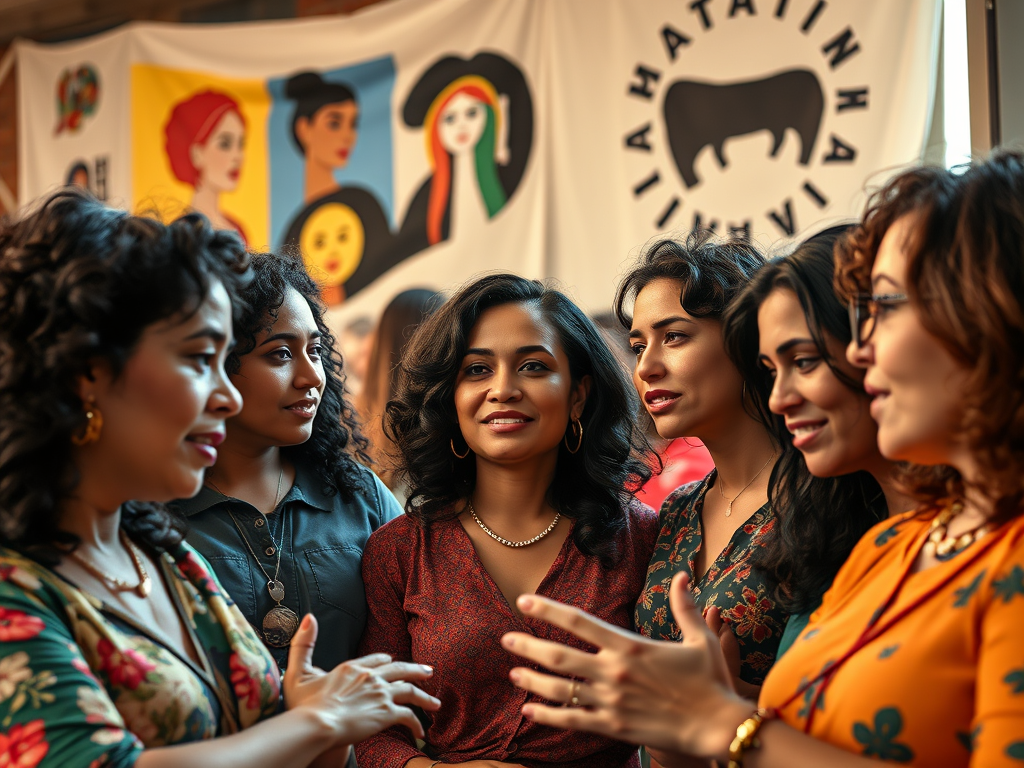

Feminism has had a blind spot: too often, “women’s issues” has meant the issues of white, middle-class women, and everyone else’s concerns get labeled “divisive.” Latina feminism exists because white feminism consistently failed to address the reality that race, class, immigration status, and culture intersect with gender. This Women’s History Month, let’s talk about why Latina feminists had to build their own movement—and what everyone can learn from it.
Why White Feminism Doesn’t Work for Latinas
White feminism focuses on breaking glass ceilings while ignoring that many women are too busy scrubbing floors to even see the ceiling. It champions “leaning in” while Latina women are working multiple jobs without benefits. It celebrates “having it all” while immigrant women fear deportation if they speak up about workplace abuse.
Mainstream feminists fought for the right to work outside the home. Latina women, Black women, and Indigenous women never had the luxury of staying home—they were working in white women’s homes, raising white women’s children, and being told feminism would get to them eventually.
The Roots: Chicana Feminism
In the 1960s and 70s, Chicana feminists within the Chicano Movement found themselves fighting sexism from men in the movement and racism from white feminists. They were told that focusing on gender issues was betraying la raza (the race/people), while white feminists told them that bringing up race was divisive.
So they built their own thing. Chicana feminists like Anna NietoGomez, Francisca Flores, and Martha Cotera created organizations, publications, and theory that addressed the intersection of race, class, and gender. They fought for reproductive justice, workers’ rights, education access, and an end to forced sterilization—issues white feminists weren’t prioritizing.
Gloria Anzaldúa: Border Theory and Mestiza Consciousness
Gloria Anzaldúa’s “Borderlands/La Frontera” fundamentally changed how we think about identity, mixing Spanish and English, poetry and theory, to describe the experience of living between cultures. She wrote about being a Chicana, a lesbian, and a woman existing in multiple worlds simultaneously. She coined “mestiza consciousness”—the ability to hold multiple, contradicting perspectives and identities at once.
Anzaldúa understood that Latina women exist in borderlands: between languages, cultures, nations, and identities. She also understood that this position, while painful, creates unique insight and power.
Cherríe Moraga: This Bridge Called My Back
Cherríe Moraga co-edited “This Bridge Called My Back,” an anthology that became a foundational text for women of color feminism. The book brought together Black, Latina, Asian, and Native American feminists who were exhausted from being marginalized within both civil rights movements and white feminist spaces. Moraga’s work centered the experiences of queer women of color and challenged the idea that we could separate our identities into neat categories.
The Issues White Feminism Ignores
Reproductive Justice Beyond Choice: White feminists focused on abortion access. Latina feminists fought forced sterilization of Puerto Rican and Mexican American women, lack of healthcare access, and family separation at the border.
Labor Rights: While white feminists fought for executive positions, Latina feminists organized domestic workers, farm laborers, and garment workers—women making poverty wages without protections.
Immigration: White feminism treats immigration as a separate issue. For Latina feminists, it’s central. Family separation, detention centers, DACA, and citizenship affect women’s ability to access education, healthcare, and protection from abuse.
Language and Culture: White feminism often expects assimilation. Latina feminism says you shouldn’t have to erase your language or culture to be respected.
The Motherhood Divide
White feminism has complicated feelings about motherhood—sometimes seeing it as oppressive, sometimes commodifying it. Latina feminism recognizes that for many communities, motherhood is both a source of cultural pride and a site of exploitation. Latina mothers are adored in the abstract but underpaid as nannies, criticized as “welfare queens,” and separated from their children at borders.
Latina feminists don’t ask women to choose between cultural respect for motherhood and personal autonomy. They demand both.
Intersectionality Before We Called It That
Before Kimberlé Crenshaw coined “intersectionality” in 1989, Latina feminists were living it. They understood that you can’t separate being a woman from being Latina, or being Latina from being working-class, or being working-class from being an immigrant. All these identities shape your experience simultaneously.
This isn’t about “having it worse” than white women. It’s about having different experiences that require different solutions.
Modern Latina Feminism
Today’s Latina feminists are continuing the work: Alexandria Ocasio-Cortez brings working-class Latina perspective to Congress. Jess Morales Rocketto and Paola Mendoza organize around immigrant rights. Julissa Arce writes about undocumented experiences. Monica Ramirez fights for farmworker women facing sexual harassment.
They’re not asking permission from white feminism. They’re building their own power.
What Real Solidarity Looks Like
If you’re not Latina and you want to support Latina feminism, here’s what helps: Listen more than you speak. Amplify Latina voices rather than centering yourself. Support organizations led by and for Latina women. Acknowledge when feminism has failed women of color. Show up for immigrant rights, workers’ rights, and reproductive justice.
And maybe, just maybe, ask yourself: whose version of feminism am I supporting, and who does it leave behind?
Keep reading: Latinx Queer Identity and Machismo Culture · Undocumented and Unafraid: DACA and Dreamer Stories · Latinx Women in STEM Fields