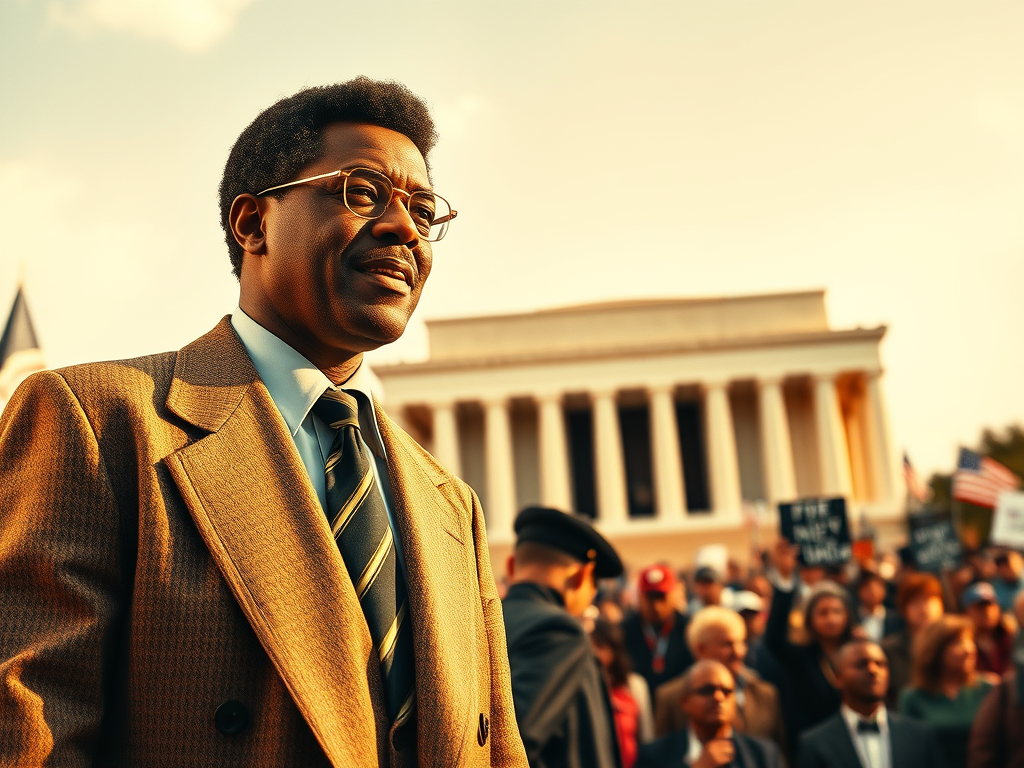

When you picture the March on Washington in 1963, you probably see Martin Luther King Jr. giving his “I Have A Dream” speech to hundreds of thousands gathered at the Lincoln Memorial. What you might not know: the person who organized that march, who made it logistically possible, who spent months planning every detail, was a gay Black man named Bayard Rustin. And the movement he helped build marginalized him because of his sexuality.
Who Was Bayard Rustin?
Bayard Rustin was born in 1912 in Pennsylvania, raised by his grandmother who was a Quaker and taught him principles of non-violence and social justice. He became a civil rights activist early, joining organizations fighting segregation and working with A. Philip Randolph, who would become a mentor.
Rustin was a brilliant strategist and organizer. He understood logistics, coalition-building, and how to mobilize massive numbers of people. He traveled to India to study Gandhi’s non-violent resistance strategies and brought those techniques back to America, teaching them to civil rights leaders including Dr. King.
He co-organized the 1947 Journey of Reconciliation, an early challenge to segregated interstate buses and the forerunner of the 1961 Freedom Rides, and led sit-ins and protests throughout the 1940s and ’50s. He advised Dr. King during the Montgomery Bus Boycott. He was the architect behind the Southern Christian Leadership Conference’s campaigns. And he was gay.
The Price of Being Out
Bayard Rustin didn’t hide his sexuality, even when doing so would have been safer and more politically expedient. In 1953, he was arrested in Pasadena for “lewd vagrancy”—essentially, for having sex with another man in a parked car. He served 60 days in jail.
This arrest haunted him. Civil rights leaders who relied on his strategic brilliance also feared that his sexuality would be used to discredit the movement. There was pressure for him to stay in the background, to let straight men take credit for work he did, to minimize his role so that racist opponents couldn’t weaponize his queerness against the entire movement.
Segregationists did exactly that. Strom Thurmond, the staunch segregationist senator, read Bayard’s 1953 arrest into the Congressional Record, attacking him as a “Communist, draft-dodger, and homosexual” to discredit the march. FBI Director J. Edgar Hoover used Bayard’s sexuality to try to undermine Dr. King and the movement.
Adam Clayton Powell Jr., a Black congressman and minister, threatened to spread rumors that Dr. King and Bayard were in a sexual relationship unless King distanced himself from Bayard. King, under pressure, did exactly that, sidelining Bayard for years.
Organizing the March on Washington
Despite being pushed to the margins, Bayard Rustin was the indispensable person who made the March on Washington happen. In 1963, A. Philip Randolph insisted that Bayard be the chief organizer. Others objected, fearing his sexuality would overshadow the event. Randolph refused to back down, and Bayard got the role—with the caveat that he’d stay behind the scenes.
In just eight weeks, Bayard organized what remains one of the largest political demonstrations in U.S. history. He coordinated transportation for over 250,000 people coming from across the country. He arranged permits, sound systems, medical support, and security. He managed logistics that would overwhelm professional event planners today, doing it with a small team and limited resources.
The march was a phenomenal success. Dr. King’s speech became iconic. Civil rights legislation gained momentum. And Bayard Rustin, the man who made it all possible, stayed largely in the background. He and Randolph appeared on the cover of Life magazine that September, and Rustin read the march’s demands from the podium, but for decades afterward his role was downplayed in the version of the story most Americans learned.
After the March: Continued Advocacy
Bayard didn’t let marginalization stop him. He continued organizing, advocating, and pushing for justice. In the 1970s and ’80s, he became more publicly vocal about gay rights, connecting gay liberation to the broader civil rights movement even when many Black leaders rejected the comparison.
He argued that movements for justice are interconnected, that you can’t fight racism while ignoring homophobia, that liberation requires solidarity across differences. This put him at odds with both homophobic Black leaders and racist white gay activists who wanted single-issue politics.
Bayard also advocated for economic justice, arguing that civil rights without economic opportunity was hollow. He supported unions, workers’ rights, and anti-poverty programs. He understood systemic oppression in ways that single-issue activists often don’t.
The Cost of Respectability Politics
Bayard Rustin’s story exposes the damage of respectability politics—the idea that marginalized groups will gain acceptance by presenting “respectable” faces and hiding members who are too visibly different.
Civil rights leaders believed that accepting gay people, especially visibly gay people, would hurt their cause. They were terrified of being smeared as sexually deviant and chose to sacrifice gay members of their movement to maintain a respectable image for straight, white America.
But respectability politics is a trap. It accepts oppressors’ framing, which says certain people deserve dignity and others don’t. It creates hierarchies within movements where some people are acceptable and others are expendable. It means you’re always one step behind, always reacting to bigots’ standards instead of asserting your own humanity unconditionally.
The civil rights movement gained legal victories, but its treatment of Bayard Rustin—a man who gave everything to the cause—was shameful. He was used for his brilliance and discarded when his identity became inconvenient.
Intersectionality and Coalition-Building
Bayard Rustin understood intersectionality before it had a name. He knew he couldn’t separate being Black from being gay, that his experiences of racism were shaped by his sexuality and vice versa. He knew that fighting only one form of oppression while ignoring others was insufficient.
He also understood coalition-building. He worked with labor unions, religious leaders, white allies, and anyone willing to fight for justice, even when those coalitions were messy and imperfect. He knew that movements need numbers and diversity to win.
This is a lesson modern activists still need to learn. Single-issue politics feels cleaner but achieves less. Building broad coalitions requires compromise, patience, and willingness to work with imperfect allies. But it’s how change happens.
Recognition Came Too Late
Bayard Rustin received some recognition before he died in 1987. President Obama posthumously awarded him the Presidential Medal of Freedom in 2013. His contributions are increasingly acknowledged in histories of the civil rights movement.
But recognition after death doesn’t undo the harm of being marginalized while alive. It doesn’t compensate for standing in shadows while others took credit. It doesn’t erase the message sent to queer Black people that their contributions matter less than their straight peers’.
Bayard’s story should make us ask: who are we marginalizing now? Whose labor are we exploiting while keeping them invisible? What brilliant strategists and organizers are we sidelining because they don’t fit respectable images?
Lessons for Today
Bayard Rustin’s legacy matters because queer people of color are still being erased from movements they build. They’re still told to tone it down, to wait their turn, to let more acceptable people lead.
Trans women of color are on the front lines of resistance but rarely in leadership positions. Queer people of color create culture, language, and strategies that get appropriated by white queer people and straight people of color alike. Their brilliance is extracted; their recognition is withheld.
If movements for justice don’t center the most marginalized, they’re not justice movements—they’re respectability projects designed to secure rights for those already closest to power.
Bayard Rustin deserved better. Current queer people of color deserve better. And if we actually honor his legacy, we’ll fight to ensure they get it.
Keep reading: Martin Luther King Jr. Day: Beyond the Quotes-His Radical Legacy · MLK’s Economic Justice Vision That History Forgot · The Women Behind the Civil Rights Movement