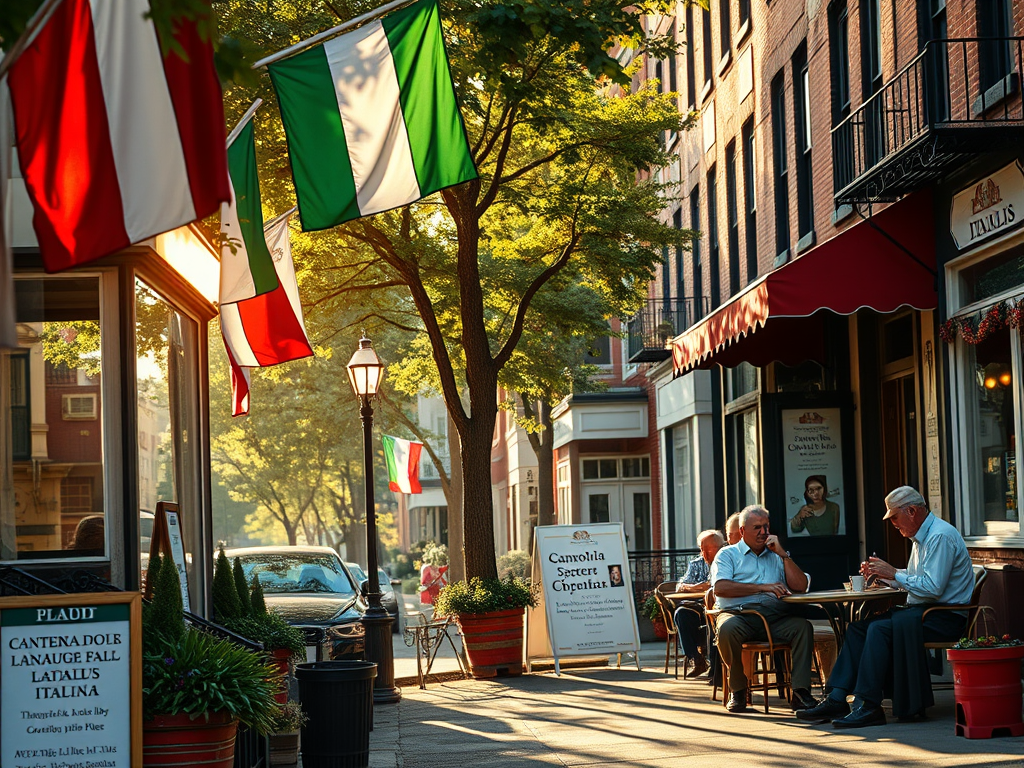

Walk through the North End in Boston, Arthur Avenue in the Bronx, or South Philadelphia, and you’ll still see the markers of Italian American life—red, white, and green flags, cannoli shops, old men playing cards outside cafes. But listen closely, and you’ll notice something missing: the language.
Italian was once the dominant language in these neighborhoods. Grandmothers shouted from fire escapes in Neapolitan dialect. Children played stickball in Sicilian. Shopkeepers conducted business in a mix of Italian and English, switching seamlessly between the two.
Today, that linguistic landscape is gone. Most Italian Americans under the age of 60 don’t speak Italian. The dialects that immigrants brought from Southern Italy and Sicily have disappeared almost entirely. The neighborhoods that were once cultural anchors have been hollowed out, gentrified, or abandoned.
This loss didn’t happen by accident. It was the result of deliberate policies, social pressures, and survival strategies. Italian Americans gave up their language to survive in America. But in doing so, they gave up something irreplaceable.
Why Language Matters
Language is more than a communication tool. It’s a carrier of culture, memory, and identity. When a language dies, it takes with it ways of thinking, stories that can’t be translated, and connections to ancestors.
For Italian immigrants, language was survival. It allowed them to navigate unfamiliar cities, find work, and build communities. It connected them to home, even when home was an ocean away.
But for their children and grandchildren, Italian became a liability. Speaking Italian marked you as foreign, uneducated, and unassimilable. Schools punished students who spoke it. Employers refused to hire people with accents. Neighbors mocked Italian immigrants with ethnic slurs for not speaking “proper” English.
The message was clear: to succeed in America, you had to speak English. And so, Italian American parents made a painful choice. They stopped speaking Italian to their children.
The Mechanics of Language Death
Language death doesn’t happen overnight. It happens across generations, through a series of small, rational decisions.
First-generation immigrants spoke Italian almost exclusively. They learned some English out of necessity, but they were most comfortable in their native language. They raised their children in Italian-speaking households, taught them the dialects of their villages, and passed down songs, prayers, and stories.
Second-generation Italian Americans grew up bilingual. They spoke Italian at home and English at school. But they also experienced the stigma of being different. Teachers corrected their accents. Classmates made fun of their packed lunches. They learned that Italian was for the old country, and English was for America.
By the time the second generation had children of their own, they made a different choice. They spoke English to their kids. They wanted to spare them the shame and discrimination they had experienced. They wanted to give them every advantage in a society that valued assimilation over cultural preservation.
Third-generation Italian Americans grew up hearing Italian from their grandparents but rarely speaking it themselves. By the fourth generation, the language was entirely gone.
This pattern repeated itself in Italian neighborhoods across the country. What took centuries to develop—the dialects of Sicily, Calabria, Naples—disappeared in America in less than a hundred years.
What Was Lost
When the Italian language died in Italian American communities, it took with it more than just words.
It took the stories that grandmothers told in dialect, stories that couldn’t be fully translated into English because the humor, the rhythm, the emotional weight depended on the original language.
It took the prayers and hymns that connected Italian Americans to their faith. Italian Catholicism had its own linguistic traditions, its own saints, its own ways of talking to God. When Italian disappeared, those traditions became harder to access.
It took the ability to communicate with relatives in Italy. For second and third-generation Italian Americans, visiting the old country became an alienating experience. They looked Italian, but they couldn’t speak the language. They were strangers in the land of their ancestors.
It took regional identity. Italian immigrants didn’t think of themselves as “Italian”—they were Sicilian, Calabrese, Neapolitan. Those regional identities were tied to dialect. When the dialects disappeared, so did the nuance. Everyone became generically “Italian American.”
It took the texture of daily life in Italian neighborhoods. The sound of Italian being spoken on stoops, in markets, in churches. The multilingual signs in shop windows. The seamless code-switching between English and Italian that allowed people to express things that couldn’t be said in one language alone.
The Death of the Neighborhood
Language loss and neighborhood decline happened simultaneously, and they reinforced each other.
As Italian Americans assimilated and achieved economic mobility, they moved out of urban enclaves. The suburbs offered space, homeownership, and distance from the poverty and crowding of the old neighborhoods. But they also offered cultural isolation.
In the suburbs, Italian American families were surrounded by non-Italians. There were no Italian markets, no feast day processions, no corner cafes where old men played briscola. Children grew up without the daily reinforcement of Italian culture that their parents and grandparents had experienced.
Meanwhile, the old neighborhoods emptied out. Businesses closed. Churches merged or shuttered. Social clubs disbanded. Some neighborhoods were demolished for urban renewal projects—expressways, housing projects, and commercial developments that displaced entire communities.
Others gentrified. As real estate values rose, Italian American residents were priced out. Their former homes were converted into luxury condos. The bakeries and delis that had served the community for generations closed, replaced by artisanal coffee shops and boutique fitness studios.
What remains today are often tourist attractions—sanitized versions of Italian culture designed to appeal to outsiders. The North End in Boston, Little Italy in Manhattan, and South Philly’s Italian Market still exist, but they’re shadows of what they once were. The people who made those neighborhoods vibrant are gone.
Can Language Be Reclaimed?
In recent years, some Italian Americans have tried to reclaim the language. They take Italian classes, use language apps, or travel to Italy to immerse themselves.
But there’s a problem: the Italian taught in schools and apps is standard Italian, not the dialects that immigrants actually spoke. Sicilian, Neapolitan, and Calabrese are distinct languages with their own grammar, vocabulary, and pronunciation. Learning standard Italian doesn’t give you access to your grandmother’s language.
Some linguists and cultural organizations are working to preserve these dialects, recording native speakers and creating teaching materials. But the effort is uphill. Most native speakers are elderly, and when they die, the language dies with them.
Even for those who do learn Italian, there’s a gap between classroom knowledge and cultural fluency. Language isn’t just vocabulary and grammar—it’s idioms, humor, cultural references, and the ability to express emotion in ways that feel natural. That kind of fluency can’t be learned from a textbook.
For many Italian Americans, the language is simply gone. And with it, a direct connection to the past.
What Remains
Despite the loss of language, Italian American culture hasn’t disappeared entirely. It’s evolved into something different—a hybrid identity that exists somewhere between Italy and America.
Food remains a powerful cultural marker. Sunday dinners, family recipes, and the rituals around cooking and eating connect Italian Americans to their heritage in ways that don’t require language.
Names, even anglicized ones, still carry meaning. A last name ending in a vowel signals Italian ancestry and connects people to a larger community.
Cultural memory persists in stories passed down through families—stories about immigration, discrimination, hardship, and survival. Even if those stories are now told in English, they still carry the weight of history.
But these cultural markers are fragile. Each generation that passes makes them thinner, more abstract, more disconnected from the lived experience of being Italian.
The Cost of Belonging
The death of Italian neighborhoods and the loss of the Italian language were not inevitable. They were the result of choices made under pressure—choices to assimilate, to fit in, to protect children from discrimination.
Those choices were rational. They allowed Italian Americans to access opportunities that would have been denied to them otherwise. But they came at a cost.
What Italian Americans gained in economic mobility and social acceptance, they lost in cultural continuity. The neighborhoods, the language, the traditions that connected them to their ancestors are gone or going.
Understanding this history means recognizing that assimilation is not a purely positive story. It’s a story of survival, yes. But also of loss. And that loss deserves to be mourned, even as we acknowledge the privileges that came with belonging.
Keep reading: Small in Numbers, Strong in Culture: Greek Americans’ Fight for Visibility · The Greek Diaspora: Maintaining Identity Across Oceans · Orthodox in America: Faith as Cultural Anchor for Greek Communities