
Greek immigration to the United States never reached the scale of Irish or Italian immigration. At its peak in the early 20th century, Greek immigrants numbered in the tens of thousands annually—significant, but a fraction of the hundreds of thousands arriving from other parts of Europe.
This small population size has shaped Greek American identity in profound ways. Greek Americans have had to fight harder for recognition, build tighter communities, and preserve their culture more intentionally than larger immigrant groups. They’ve done so through institutions—churches, schools, social organizations—that remain vibrant more than a century after the first major wave of Greek immigration.
The Greek American experience is a story of strategic cultural preservation in the face of assimilation pressure. It’s a reminder that minority status isn’t just about oppression—it’s also about resilience, adaptation, and the deliberate choices communities make to survive.
The First Wave
Greek immigration to the United States began in earnest in the 1890s and continued through the 1920s. Most immigrants came from rural areas of Greece, fleeing poverty, political instability, and limited economic opportunities. They settled primarily in urban centers—New York, Chicago, Detroit, Pittsburgh—where they found work in factories, restaurants, and small businesses.
Unlike Italian or Irish immigrants, Greeks arrived with certain advantages. Many were literate. Greece had compulsory education laws, and even rural Greeks often had basic reading and writing skills. This literacy helped them navigate American society more quickly than some other immigrant groups.
But they also faced significant challenges. Greeks were Orthodox Christian in a nation dominated by Protestants and Catholics. They spoke a language that had no linguistic relatives in Western Europe. Their food, customs, and social norms were unfamiliar to most Americans. And they were small in number, which meant they had less political clout than larger immigrant groups.
The response was to build strong, insular communities centered around the Orthodox Church.
The Church as Cultural Anchor
For Greek immigrants, the Orthodox Church was more than a place of worship. It was a cultural, social, and linguistic hub. Services were conducted in Greek, preserving the language across generations. Church festivals celebrated Greek holidays and saints. Social events reinforced community bonds.
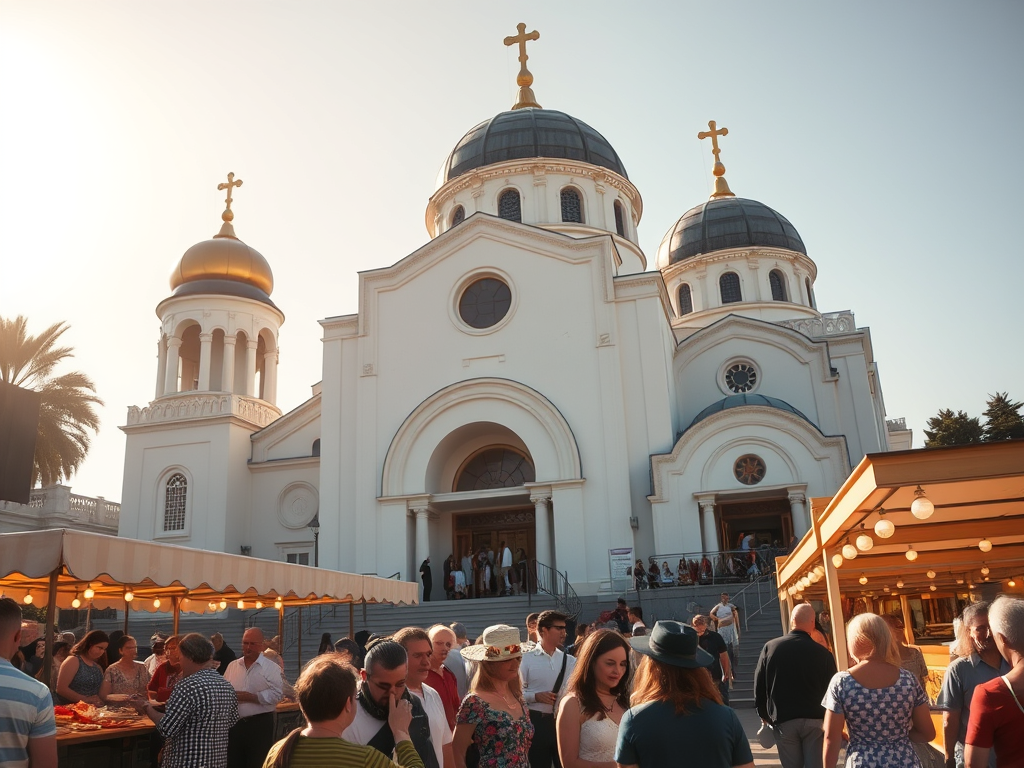
Greek immigrants built churches wherever they settled—small parishes in industrial cities, grand cathedrals in major metropolitan areas. These churches became the center of Greek American life. Baptisms, weddings, funerals, and feast days brought the community together.
The church also provided social services. It helped new immigrants find housing and jobs. It offered language classes, youth programs, and charitable assistance. In an era before government safety nets, the church was the primary institution supporting Greek Americans.
This centrality of the church had lasting effects. Greek Americans remained more religiously observant than many other ethnic groups. Even today, the Greek Orthodox Church is a defining feature of Greek American identity. Attending church, celebrating Greek Easter, and participating in cultural festivals are ways that Greek Americans maintain connection to their heritage.
Language Preservation
Unlike many immigrant groups, Greek Americans managed to preserve their language across multiple generations. This success is partly due to deliberate institutional efforts.
Greek language schools, often affiliated with churches, provided after-school instruction in reading, writing, and speaking Greek. Children who attended American public schools during the day spent afternoons and weekends learning Greek.
These schools weren’t just about language—they taught Greek history, culture, and Orthodox Christianity. They reinforced the idea that being Greek American meant maintaining a connection to Greece, not just assimilating into American society.
The results have been mixed. Third and fourth-generation Greek Americans are less likely to speak fluent Greek than their immigrant grandparents. But many still have conversational ability, and the language remains present in church services, family gatherings, and cultural events.
This level of language preservation is unusual among white ethnic groups. It reflects the intentionality of Greek American institutions and the strength of cultural identity within the community.
Small Numbers, Tight Communities
The small size of the Greek American population has been both a challenge and a strength.
On one hand, it has limited political power. Greek Americans don’t have the voting bloc that Irish or Italian Americans can mobilize. They’re less visible in national politics, and their cultural contributions are often overlooked.
On the other hand, small numbers have forced Greek Americans to build exceptionally strong community networks. Everyone knows everyone. Families are interconnected through marriage, business partnerships, and church membership. This tight-knit structure has preserved cultural practices and reinforced group identity.
Greek American organizations like AHEPA (American Hellenic Educational Progressive Association) and the Greek Orthodox Archdiocese provide national coordination and advocacy. These organizations lobby for Greek causes, support education, and promote cultural heritage.
Local Greek communities also maintain strong identities. Greek festivals, often held annually at Orthodox churches, draw thousands of attendees—Greek Americans reconnecting with their heritage and non-Greeks experiencing Greek food, music, and dance.
These festivals serve multiple purposes. They raise money for churches and schools. They introduce Greek culture to broader American audiences. And they give Greek Americans, especially younger generations, a tangible connection to their ancestry.
Navigating Whiteness
Greek Americans occupy a complicated position in America’s racial hierarchy. Legally and socially, they’re classified as white. But their cultural distinctiveness and Orthodox faith have sometimes placed them outside the mainstream.
In the early 20th century, Greeks faced discrimination similar to other Southern and Eastern European immigrants. They were stereotyped as swarthy, clannish, and un-American. Anti-immigrant sentiment targeted them alongside Italians, Poles, and Jews.
By the mid-20th century, Greek Americans had achieved economic mobility and social acceptance. They moved into middle-class professions—doctors, lawyers, business owners. They bought homes in suburbs. They sent their children to college.
But unlike many Irish and Italian American families, who assimilated more fully, Greek Americans maintained stronger cultural ties. This was partly due to the church, which provided institutional continuity. It was also due to pride in Greek civilization and history.
Greeks have a unique claim to European heritage. Ancient Greece is celebrated as the birthplace of democracy, philosophy, and Western civilization. This association gives Greek Americans cultural capital that other immigrant groups lack. Being Greek means being connected to Plato, Aristotle, and the Parthenon—not just poor immigrants fleeing poverty.
This historical legacy has allowed Greek Americans to maintain ethnic pride without being seen as clannish or backward. It’s a privilege that shapes how Greek identity is perceived and preserved.
The Second Wave
Greek immigration didn’t end in the 1920s. A second wave arrived after World War II and the Greek Civil War (1946-1949). These immigrants were different from their predecessors—more educated, more politically aware, and often fleeing political persecution rather than just economic hardship.
This second wave revitalized Greek American communities. They brought new energy to churches, started Greek-language newspapers, and reinforced cultural institutions. They also complicated Greek American identity by introducing political divisions—between royalists and republicans, between those who supported the military junta in Greece and those who opposed it.
These political divides have faded over time, but they illustrate an important point: Greek American identity is not monolithic. It’s shaped by regional origins (Crete, the Peloponnese, the islands), political beliefs, generational differences, and levels of assimilation.
Challenges and Opportunities
Today, Greek Americans face questions about cultural survival. Intermarriage rates are high. Younger generations are less fluent in Greek and less religiously observant. Urban Greek neighborhoods have largely disappeared, replaced by suburban dispersion.
But Greek American institutions remain strong. The Orthodox Church continues to serve as a cultural anchor. Greek schools, though fewer in number, still operate. Cultural organizations adapt to changing demographics by incorporating non-Greek spouses and children into community life.
Greek Americans also benefit from Greece’s continued existence as a nation-state. Unlike immigrant groups whose homelands no longer exist in the same form, Greek Americans can travel to Greece, learn the language, and connect with living culture.
This ongoing relationship with the homeland creates opportunities for cultural renewal. Young Greek Americans study abroad in Greece, participate in diaspora programs, and engage with contemporary Greek culture—music, film, literature.
The challenge is balancing preservation with evolution. Greek American identity can’t remain static. It must adapt to new generations while maintaining core elements—language, faith, cultural practices—that connect people to their heritage.
Visibility in a Multicultural America
Greek Americans remain relatively invisible in mainstream American culture. There are Greek American celebrities—Jennifer Aniston, Tina Fey, John Stamos—but Greek culture doesn’t have the same pop culture presence as Italian American or Irish American culture.
This invisibility is partly a function of numbers. Greek Americans make up less than 1% of the U.S. population. But it’s also a choice. Greek American cultural preservation has focused on internal community-building rather than external visibility.
In recent years, some Greek Americans have pushed for greater recognition. They’ve advocated for curriculum inclusion, historical markers, and public acknowledgment of Greek contributions to American life.
These efforts face challenges. In a multicultural society increasingly focused on race and racism, white ethnic identities like Greek American can seem less urgent or less deserving of recognition. The fight for visibility competes with the struggles of communities facing active discrimination.
But Greek American history and culture remain valuable—not because they’re more important than other stories, but because they add complexity to the American narrative. They show that immigration, assimilation, and cultural preservation are ongoing processes. They remind us that identity is something you build, not just something you inherit.
Greek Americans fought for visibility by building institutions, preserving language, and maintaining culture across generations. That fight continues, smaller and quieter than others, but no less important to the people engaged in it.
Keep reading: The Greek Diaspora: Maintaining Identity Across Oceans · Orthodox in America: Faith as Cultural Anchor for Greek Communities · Appalachian Pentecostals: Class, Faith, and Regional Othering